Twelve-year-old Nancy Crumpet lives above a bakery and her life is a delightful mix of flour, salt, and love. Yet her mind is brimming with questions no one can answer: Why did her birth parents disappear? Why can she speak with the sky? And why must she keep her mysterious birthmark hidden?
Everything is about to change when the Scareground returns to Greenwich. Nancy is convinced it holds the answers to her parents’ disappearance. Nancy and her best friend Arthur Green meet the fair’s spooky owner, Skelter, and discover a world full of dark magic and mystery. Nancy must confront her greatest fears to get to the truth. But is she ready for all the secrets the Scareground will reveal?
Review
This is a strong debut by Angela Kecojevic, bringing us a story steeped in family secrets, traditions, friendship, differences and a few scares thrown in for good measure.
The author has built a world around the Victorian era we know, bringing a sense of fear and dread to it by adding in illusions (or are they just tricks) that mess with your eyes and your mind, whilst Nancy and Arthur dig deep to brave the dangers and face their fears to get to the bottom of Nancy’s links to Skelter Tombola and the Scareground.
Nancy’s relationship with/to the sky is an added element that we are never quite sure is an advantage or will bring her more peril.
Whilst the ending brought some answers for Nancy, there is definitely more to her past and her special abilities than revealed here, leaving the door wide open to further speculation and hope that there will be a second novel on the way.
Special mention must also go to the map at the start…I do love a book map.
Thank you to @NeemTreePress and @The_WriteReads for an advance copy in exchange for this review.
I recently read and loved The Pawnshop of Stolen Dreams (reviewed here) by Victoria Williamson, so I was keen to read her new book.
The two books could not be more different but they are both superb in their own way.
Blurb
Two very different lives. One shared hope for a brighter future. No time to waste. The flood is coming…
Eleven-year-old Norah Day lives in temporary accommodation, relies on foodbanks for dinner, and doesn’t have a mum. But she’s happy enough, as she has a dad, a pet mouse, a pet spider, and a whole zoo of rescued local wildlife to care for. Eleven-year-old Adam Sinclair lives with his parents in a nice house with a big garden, a private tutor, and everything he could ever want. But his life isn’t perfect – far from it. He’s recovering from leukaemia and is questioning his dream of becoming a champion swimmer. When a nest of baby birds brings them together, Norah and Adam discover they’re not so different after all. Can Norah help Adam find his confidence again? Can Adam help Norah solve the mystery of her missing mother? And can their teamwork save their zoo of rescued animals from the rising flood? Offering powerful lessons in empathy, Norah’s Ark is a hopeful and uplifting middle-grade tale for our times about friendship and finding a sense of home in the face of adversity.
Review
Norah and Adam live totally different lives…but neither is perfect.
Neither of them want the other to know their own realities, they do not want each other’s pity, just friendship. They also do not want their parents finding out about their friendship. This leads to a lot of wrong assumptions and unknowingly saying the wrong thing. However, their common interest in each wanting a friend, wishing for a pet and trying to look after random wild or feral animals brings them together.
The alternating chapters from Norah and Adam’s points of view are really effective in telling this story.
Norah’s Ark covers a lot of themes; bullying, poverty, homelessness, child illness, climate change. Separately they are all huge, heavy themes in themselves, but the author brings them together in this story with a deft hand, making it accessible for children to read and build awareness.
She adds in a measure of how each character perceives themselves and others, their lack of awareness of how keeping things to themselves makes it worse for everyone and how piling those secrets and lies up is bound to come crashing down around them at some point.
Williamson has written a beautiful story about awful situations that opens up space for discussions about the different themes in an accessible way.
Books are a window or a mirror for the reader. Or, in the case of this book, with so many different elements, it can be both. Whichever this is for you, use it to be more understanding of the situation of others or know that you not alone.
Thank you to @NeemTreePress and @The_WriteReads for an advance copy of the book in order to provide this review.
In a strange little village called Witchetty Hollow, eleven-year-old Florizel is the first to run into the curious visitors who’ve come to open a brand new Daydream Delicatessen and sack-baby factory.
At first, it seems the daydream confection and cheap sack children are the best things that could have happened to the poor folk of the Hollow – after all, who has the money to rent their child from Storkhouse Services these days? But after a few weeks, Florizel starts to notice something odd happening to the adults of the town. First, they seem dreamy, then they lose all interest in their jobs and families. Soon they’re trading all their worldly goods in the newly-opened Pawnshop for money to buy daydreams. With no money for rent payments, the children of Witchetty Hollow are being reclaimed by Storkhouse Services at an alarming rate. Florizel needs to act.
Review
This is a dark, sinister story that made my skin crawl at times but it is ultimately filled with hope.
Victoria Williamson has cleverly created a deeply creepy, Grimmesque fairy tale world, covering themes of greed, addiction and capitalism alongside those of friendship and community suitable for young readers (9+) that will have them fearful for Florizel and Burble but also page turning hopefully to find out what happens next.
There is a wide range of characters, from mostly good to downright wicked, in particular the child repossessing “nurses” who are just as ominous and scary as the infamous child catcher in Chitty Chitty Bang Bang.
Illustrations by James Brown
The dark and light of the story is reflected in the descriptions. The Dream Delicatessen and Pawnshop evoke scenes bursting with colour and sparkle, in stark contrast to the rest of the town, which is shrouded in gloom and despair. James Brown’s black and white illustrations capture the drama and atmosphere perfectly.
In Scotland, dressing up at Hallowe’en and visiting other houses is called guising. The fear inducing Gobbelino guisers, in their cloaks and masks, made me reminisce about a childhood Hallowe’en where someone (a friend of my parents) came guising to our house in a huge coat and mask and, to this day, I still do not know who it was. This story is as creepy as I felt that night.
Thank you to Tiny Tree Books and The Write Reads for a free digital copy of the book for review purposes.
In the harsh winter of December 1889, the sailing vessel Irex leaves Scotland, bound for Rio de Janeiro. She carries three thousand tons of pig iron and just three passengers for what should be a routine voyage. But Captain Will Hutton soon discovers that one of his passengers hides a horrifying secret that threatens the lives of everyone on board. As the Irex battles relentless storms, Hutton fights battles of his own as he becomes mired in the intrigues of his passengers.
When the Irex is wrecked off the Isle of Wight six weeks later, it falls to the county coroner, Frederick Blake, to unravel the events that overtook the doomed ship. He quickly runs into opposition – powerful forces within the British Establishment are working to spike his inquest. Locked in a conflict with the sinister agents sent to obstruct the investigation, he begins to discover that nothing aboard the Irex is what it first seemed, while the evil that stalked the ship now threatens anyone who seeks to expose it…
Irex is an atmospheric mystery, set in a rich Victorian world, packed with intrigue, twists and unforgettable characters — the gripping first novel by Carl Rackman.
Review
The story is told via alternating chapters…the ill-fated maiden voyage of the Irex and the inquest into the wreck. The format works well and as the story unfolds, you realise how unreliable individual viewpoints are and that every angle needs to be brought together to get to the truth. However, with some passengers not surviving the voyage, others missing and those who give testimony unclear about some aspects of what actually happened, this proves difficult for the coroner.
Rackman succeeds in immersing us in the world of Victorian sea faring. His descriptions of the ship are precise, enabling the reader to envision being aboard. The claustrophobic sense being on a ship gives you is strong. The chapters on the storm and wreck are vivid, detailed and build the tension superbly, as does his handling of the ever increasing suspense and danger the coroner and his colleagues find themselves in.
The author develops rounded, believable characters. They are human, make mistakes and are often either second guessing themselves or in conflict with themselves about what to do next.
Rennie, the Glasgow journalist, is, to me, a Victorian version of Brookmyre’s Jack Parlabane.
A thoroughly enjoyable read.
Thanks to #TheWriteReads for a digital copy of this to review for this #BlogTour .
This is not going to be a normal review post. I am joining Ben Harris (@one_to_read) and others on Twitter this month to celebrate the work of Jan Mark. I will add to the blog (not promising it will be daily) on my readings over the month. They are more notes than a narrative. I apologise in advance if they seem disjointed, I am finding new links as I read and type these. I may return to previous days and add/edit as I read further.
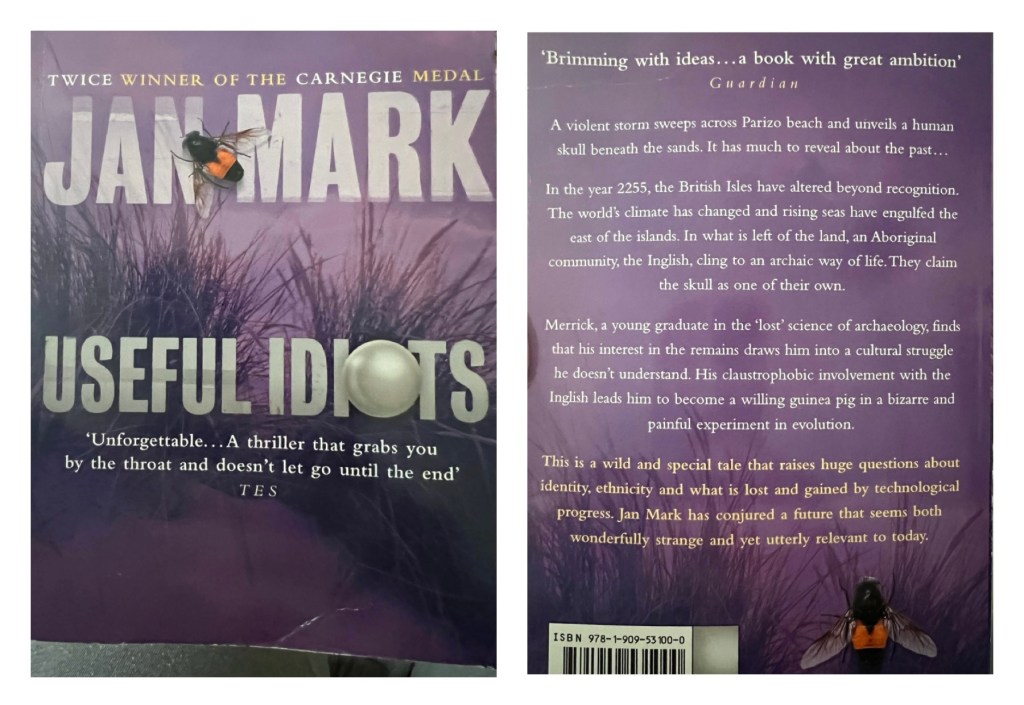
Having mostly read short stories in previous #janMARKuary Januarys, I am starting with a novel this time, Useful Idiots. I will read a chapter a day for 13 days then chose something else.
1st January
I want to focus on Jan’s vocabulary choices and the descriptive images she creates and enhances with the use of one or two extremely well appointed words.
glistened oilily – even saying the word oilily out loud adds texture to the description.
the scything wind – no added comments needed here, we all know what this feels like.
“the auditorium…was raked, with long curving rows of seats” – typing this made me think Jan is linking human made structures with the land and fits in with other imagery and word choices in the text so far.
plastered maquillage (I had to look that up) – there is a passage later in the chapter that builds on this, that shows how caked on the stage make up was.
obdurately blank – Jan uses this phrase to describe a screen wall in a theatre, conjuring audience impatience for the show to start.
city canyons – appears in the middle of a description of a landscape ravaged by a hurricane. I immediately imagined a sweeping view from a drone flying over/down the streets of a very build up urban landscape.
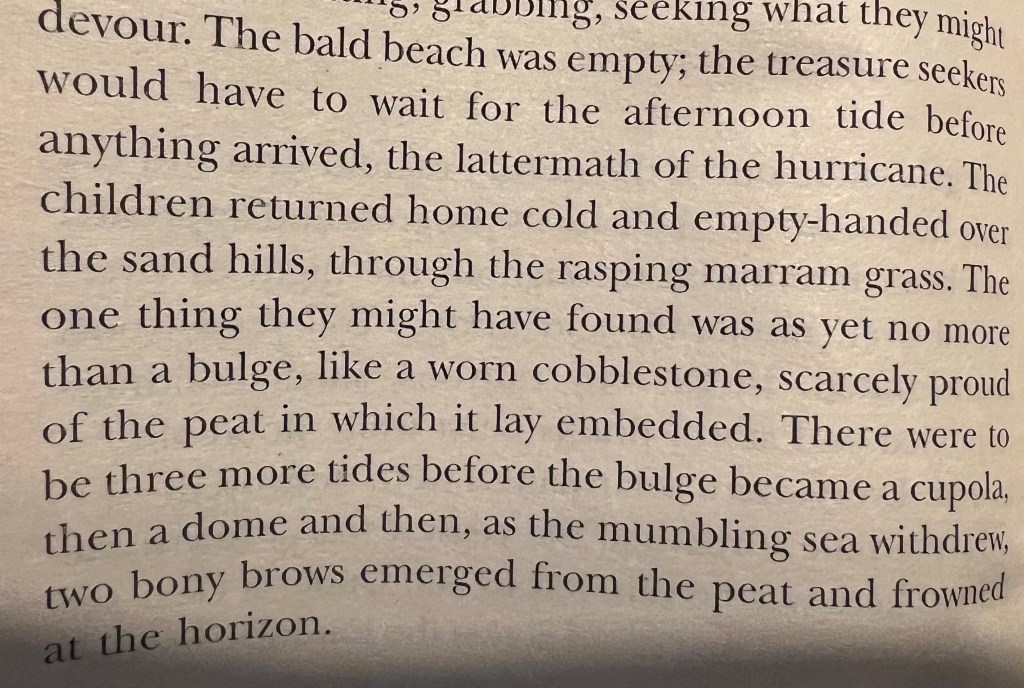
“lattermath of the hurricane” feels like it should jar, but it doesn’t. The dictionary definition refers to the second mowing of a crop. Jan has used it to detail something buried in the sand, “scarcely proud”, that would be further exposed once a second tide had ebbed and flowed. Here is the full paragraph is all its glory.
Archaeology is key to this story and Jan’s phrasing and word play is wonderful. She describes the work of the archeologists as cutting “into their past through a layer cake of centuries”.
Buildings are falling or being dismantled (reasons not yet known) and new builds will be erected, pinning down the past”.
2nd January
The second chapter gives us more details about cultural tensions, the uncovered skull being discovered close to or on the unmarked border between territories. I will look at this as we go further into the story and get more detail.
However, I want to look at the tension between two characters today: Merrick Korda, a graduate trainee, and his archaeologist boss Remy Turcat. So far, we see this from Merrick’s point of view, but it tells us a lot about Turcat’s character. It is unclear if the tension is purely a power one based on position in the organisation or if there are other things at play.
Is Merrick one of the useful idiots of the title? This is not clear yet. But Turcat definitely treats him like an inferior being. Jan describes this all too familiar treatment well, also reflecting the wider cultural tensions, not just that between the two individuals.
“Turcat had neither welcomed him nor turned him away: he was expected.”
“He regarded Korda as little as his own shadow: it was always there beneath him; he did not expect it to speak.”
“…validating Merrick’s suggestion by appropriating it.”
“Turcat looked across at Merrick and had to acknowledge him.”
“He was used to being invisible but not so invisible that he was forgotten.”
There is a definite sense of othering going on from a position of privilege.
3rd January
As the skeleton discovered on the beach is unveiled, slowly, layer by layer from the peat surrounding it, so Jan cleverly reveals the layers of cultural mistrust, misappropriation and history behind the conflict between the indigenous, “archaic” Inglish and the others (so far no name has been attached to them).
Despite Turcat’s dismissive attitude towards Merrick, when it is revealed that he is descended from the Inglish, although he has neither lived in their territories nor followed their lifestyles, Turcat is surprised. This leads me to believe his othering and unbotheredness of Merrick has, up to this point been down to position and privilege. Their boss, on the other hand is downright racist and does not hide it, once Merrick’s ancestry has been voiced aloud.
The way Jan has written the two narratives as one, unpeeling layers to get us to the truth of the matter, is highly skilled and a testament to her skills as a writer.
4th January
Merrick is told to get lost for a couple of days by his boss. He gets on the wrong train and ends up being manipulated into visiting the fen land of the Inglish by someone he has only met once, by chance. The manipulation is subtle and well executed considering it was a chance encounter.
10th January
I finished quicker than anticipated as I was so drawn into the story I could not limit to one chapter a day.
Even though written in 2004, a lot of what Jan has written in here is relevant today: unions, riots, suppression of indigenous people.
The useful idiots of the title are the general population, manipulated into certain behaviours by the media and rich business people with agendas of their own to achieve their goals. Merrick is also a useful idiot, both to Turcat and to the Aboriginals, even more so with the decision he makes without their knowledge.
I had to check the definition of Aboriginal, as Jan chose it to define the indigenous people of Europe, not something I was familiar with.
My understanding/knowledge of the words is in reference to the indigenous people of Australia. The other definition is not place specific: The aboriginal people or animals of a place are ones that have been there from the earliest known times or that were there before people or animals from other countries arrived.
Manipulation is a strong theme running through this story. Manipulation of university departments and staff, protestors, the general public, the indigenous population individuals and in Merrick’s case, his own body. The reasons for, and outcomes of, the manipulation are different in each case and the outcomes not all what was anticipated.
Although described as a YA novel, this presents more as an adult read. I cannot quite put my finger on why. It is definitely not an MG. All the characters are adults. There is no reason it could not be a YA, the themes and content are appropriate and suitable for YA discussion and interpretation.
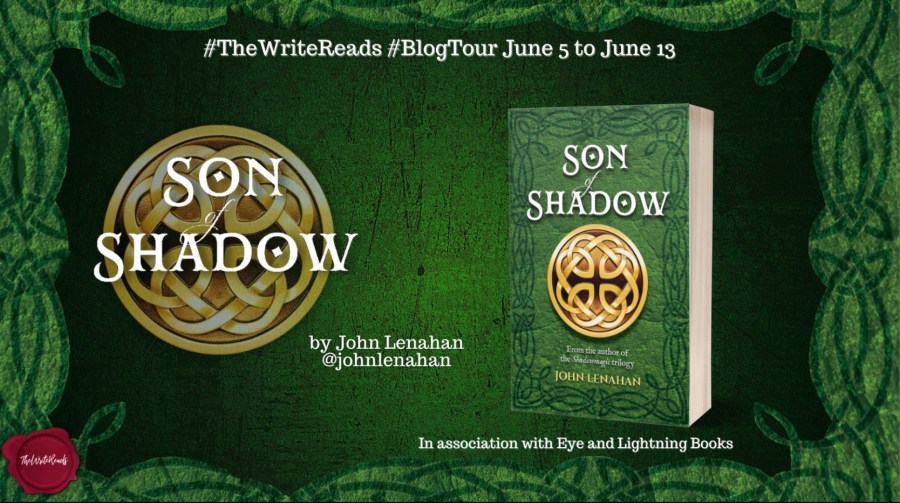
Son of Shadow is the start of a new fantasy trilogy, following on from the Shadowmagic Trilogy. Admission…I have not read the original trilogy but will be rectifying that soon. This omission did not detract from my enjoyment of the book, but would have helped in following who was who as the story unfolded.
Thanks to The Write Reads @The_WriteReads and Eye and Lightning publishers for the advanced copy to review.
Blurb
A world of faeries, leprechauns and dragons – and magic fuelled by the blood of trees.
A mystery portal to the Real World.
And a pair of curious young adventurers who know they shouldn’t step through it…
Meet Fergal the Second, nicknamed ‘two’. Or ‘Doe’, in his own language. He can do magic. But, for the moment, he’s forgotten where he’s from. Or what’s happened to his blind friend Ruby.
He’s actually from Tir na Nog, the enchanted world of Shadowmagic, where a new generation of the royal House of Duir are cheeking their parents, preparing for adulthood and itching to see the Real World for themselves – whatever the peril.
Review
The story is split into three parts. The first covers Fergal’s introduction to the Real World, where he has no memory of where he came from, who he is or what he is doing. Something is clear though…he loves Real World pizza.
He does know how to make coins disappear, not slight of hand like a stage magician, but actually disappear. He then struggles to understand why he gets into trouble for doing so, despite being told he won’t, as the coin owners think it is deception, not magic.
Fergal then works out that he needs to find his sister. On his travels, having escaped from an asylum, he meets people who know of his faerie home land and of his family, some helpful, some not. With help, and some setbacks, he manages to get to where he needs to be, but still cannot find his sister.
The second part is set back in Tir na Nog, Fergal’s home. We discover through his memories who he is, how his sister disappeared and how his homeland is linked to the Real World. We also meet his family and friends.
Fergal is a cheeky teenager who rebels against his family’s teachings at times but at heart is a good kid. He learns the hard way that putting off admitting something to those who can help does not always end well,
The final part brings the two worlds together. Fergal and his friends have to work together, using magic to rescue not only his sister but also other family members from an evil sorceress.
The ending sets up for the next instalment very well, with Fergal saying “Oh cack” at what is to come, and I for one am already looking forward to continuing the story. It is at this point that reading the original trilogy would have been most helpful.
The author has created well rounded characters, warts and all, and the world building, especially Tir na Nog, is exceptional.
Book Info
Genre: Fantasy
Length: 310 Pages
Publishing: 25th June 2022
About the Author
Born in Philadelphia but long settled in the UK, John Lenahan is an acclaimed magician and TV performer. He fronted his own BBC2 magic series Stuff the White Rabbit, played the voice of the toaster in Red Dwarf and has appeared on a wide range of entertainment shows including TFI Friday, Comedy Café and Celebrity Squares. He is a member of the exclusive Magic Circle. He is also the author of the popular Shadowmagic trilogy, a fantasy adventure series for young adults which combines Irish folk myth with 21st-century wit. Son of Shadow takes up the story once more, following the noble houses of the magical parallel world of Tir na Nog into the next generation.
A twisty tale of magicians, con artists and card games, where secrets are traded and gambled like coin, for fans of The Lies of Locke Lamora and The Mask of Mirrors.
Never stake more than you can afford to lose.
When failed magician turned cardsharp Valen Quinol is given the chance to play in the Forbearance Game—the invitation-only tournament where players gamble with secrets—he can’t resist. Or refuse, for that matter, according to the petty gangster sponsoring his seat at the table. Valen beats the man he was sent to play, and wins the most valuable secret ever staked in the history of the tournament.
Quinol’s hand is forced, he wins the secret and, despite passing it on as agreed, the lives of his family and friends are put in danger. Not only that, but the secret could cause war to break out. This was definitely not on the cards (sorry!) when he accepted the task.
He has to use all his cardsharp tricks, his unfinished, unrefined magic training and rely on the skills of his con artist wife and friends (the only family he has) to work out a way to stop the keepers of the secret killing anyone who learns the truth and prevent what looks like inevitable war breaking out. Not easy when he only has fragments of information and, unlike in the card games he is used to playing/fixing, cannot predict the other players’ next moves.
Livingston’s world building is creative and strong, based on a range of political goings on and that of unseen magic.
The world of gambling and card playing cons was an eye opener to me…so many tricks and tells. That Quinol is so good is evident in his reading of his friends when away from the casino tables.
The story is a slow burner to start with, as the scene is set with a lot of information about the characters and the backstory. However, once the secret is won, the action hots up. Telling the story via the point of view of several of the key characters works well and gives a rounded perspective.
I particularly enjoyed the fact that the “hero” was flawed and questioned his own motives and morals, whilst trying to protect the ones he loves.
One grumble…the blurb gives away too much of the storyline before you even start.
Thanks to Rebellion Publishing for the eARC as part of #TheWriteReads blog tour.
A quiet English town that thrives on local produce, old fashioned values, and survival against the rule of an Eldritch Abomination. Here, you will enjoy endless walks, soothing sounds, forceful avatars, and the kind of joys that only an English township can bring!
(Please note: this dossier has been compiled by the BPD based on materials found relating to P1983 – or Wilthaven as you know it. Treat every sentence, word, image, and syllable with the utmost paranoia. Be safe.)
Wilthaven is a horror comedy.
Review
Wilthaven exists but it doesn’t.
The Bureau of Paranormal Discoveries (BPD) has been investigating it for many years. Reports, recordings and documents, as well as encounters with residents of Wilthaven, are presented here, building up the history of a place not in our dimension, in order to decide if it is threat to our way of life.
In Wilthaven, the normal rules of science and nature do not apply.
The Crest family has been in charge for generations. The Wilthaven Way is their code of conduct.
There is a nighttime curfew and severe consequences for those who do not comply with it, but not from the authorities of the town. For those that do comply, a good night’s sleep is not guaranteed.
Do not go into the Wilthaven woods. You may or may not come out. If you do, you will never be the same again.
How did the materials related to Wilthaven come to exist in different worldwide locations in our dimension? What happened and is still happening there? What are the origins of the scratching and screaming during the hours of darkness? Who are the avatars? So many questions (and also shivers) arise from reading this dossier. A few laugh out loud moments too.
The materials are presented in the order they were uncovered, not chronologically. This leaves the reader piecing the story together part by part, which I liked. The items recovered are not always complete. However, the missing/lost sections confidently leave a lot to the reader’s imagination: a feeling of unease, a building horror of what happens to the people who encounter whatever is actually ruling Wilthaven, because it is definitely not the Mayor.
The drip feeding of information, the frustration of missing (damaged or retracted) details, linking the story together as each item in the dossier is revealed was, for me, very reminiscent of reading Michael Crichton. High praise!
There is also a sub story concerning the agents who document and act on the materials. The dossier format cleverly allows us to follow this via the lead agents summaries and Director’s notes.
I will definitely be on the lookout for more of Oli Jacobs’ spine tingling work.
I received this book to read and review as part of the 2021 BBNYA competition and the BBNYA tours organised by the TWR Tour team. All opinions are my own, unbiased and honest.
BBNYA is a yearly competition where Book Bloggers from all over the world read and score books written by indie authors. If you are an author and wish to learn more about the BBNYA competition, you can visit the official website http://www.bbnya.com or twitter @bbnya_official.
The sign-ups will soon be open for the 2022 BBNYA competition, be it for authors to enter their books, or for bloggers wanting to be part of the new panel, so keep your eyes peeled!!
Book Info
Publisher: Independently published
Length: 362 Pages
Date Published: April 27th, 2020
About the Author
Oli Jacobs is a bearded chap who enjoys spinning a yarn or two. While now a hermit, he has been rumoured to be seen drinking beer and enjoying chicken in the wilds of Southampton. If seen, please approach gently as he has severe anxiety and may cry.
As well as Wilthaven, Oli has also written other Horror (The Children of Little Thwopping, The Station 17 Chronicles), Comedy (the Kirk Sandblaster series), Thriller (the Mr Blank series), and short stories (the Filmic Cuts series).
This is not a new book, it was published in 2017. I discovered it by chance, having seen a different book on Twitter and following a link to the publisher’s website (@cranachanbooks https://www.cranachanpublishing.co.uk/ ). Being Scottish, with a fascination for Victorian times and also Punch and Judy, I obviously ordered it. I also ordered some other books, but that is for another blog.
Punch tells the story of Phineas, an orphan living in 1889 Inverness under the volatile guardianship of his “Uncle” Ewan. He is sent on a nighttime errand, which ends with the town market halls being set on fire. Falsely accused and justifiably scared of the reaction of his guardian and the police, Phineas goes on the run.
He forms unlikely alliances with an escaped prisoner and a family of travelling entertainers on his journey, which includes encounters with a dancing bear and Queen Victoria. He learns new skills, including becoming a puppeteer. He also has a bounty on his head, wanted for arson. Can he clear his name? Can he resolve his issues with his turbulent past? How he became orphaned is haunting him. This and way he was treated by his guardian means he struggles with trusting his new companions. Are they on his side or biding their time to turn him in for the money?
Barbara Henderson has written a gripping story based on a true event (the market halls in Inverness did burn down). The strength of this story is in the characters: their backstory, their relationships with each other, how they support each other to make sense of what has happened to them and how they finally resolve misunderstandings of their own and other people.
Themes of broken families, living with a bullying adult, friendship and trust run through the story, as does compassion, hope and love. When I took a break from reading, I was thinking of Phineas and his predicament and I wanted to get back to it as soon as possible…the sign of a very good book. I plan to read more of Barbara’s books.
Exiled, with her sisters, to a far-flung island by the whims of the gods, Medusa has little company except the snakes that adorn her head instead of hair. But when a charming boy called Perseus arrives on the island, lost as he sails the seas on a quest to save his mother, her lonely existence is disrupted with the force of a supernova, unleashing desire, love and betrayal…
The stunning illustrations throughout the book, by Olivia Lomenech Gill really being the island world of Medusa alive.
Jessie Burton has retold this myth superbly, bring it bang up to date with the feminist slant it very much needed. It is told from the view point of Medusa and because of this, the themes come across much more emotionally and with impact.
As Medusa and Perseus gradually tell each other their reasons for being on this far-flung island, we can see that perception of themselves and others is a very personal thing. Perseus holds Poseidon in high regard, Medusa hates him with a vengeance. Similarly, their views on Athena differ too.
There are strong themes of self worth, perception of how you are viewed by others and how this affects your behaviours and attitudes, how the opinions (real or perceived) of others impact on you and ultimately change you.
There are strong themes of consent and respect. Medusa’s feelings of how Poseidon should have behaved towards her (as opposed to abusing his power) and how she was not to blame are deeply felt. Her sisters’ allyship is strong but not all other women are her ally. Athena’s use of privilege and power are selectively abusive.
The promises we make…do we actually know what we are promising at the time? Open ended promises are not always good ones.
Throughout the retelling, Medusa’s view of herself, others in her life and her awareness of how the rest of the world perceives her opens up opportunities for conversations to be had. Important conversations.
Thank you to NetGalley and Bloomsbury for the eARC review copy.








 Beth's Bookcase