A diverse resistance force fights to topple an empire in this vibrant fantasy about freedom, identity and decolonization.
By sinking a fleet of Imperial Warships, the Pirate Supreme and their resistance fighters have struck a massive blow against the Emperor. Now allies from across the empire are readying themselves, hoping against hope to bring about the end of the conquerors’ rule and the rebirth of the Sea. But trust and truth are hard to come by in this complex world of mermaids, spies, warriors, and aristocrats. Who will Genevieve – lavishly dressed but washed up, half dead, on the Wariuta island shore – turn out to be? Is warrior Koa’s kindness towards her admirable, or is his sister Kaia’s sharp suspicion wiser? And back in the capital, will pirate-spy Alfie really betray the Imperials who have shown him affection, especially when a duplicitous senator reveals xe would like nothing better?
Meanwhile, the Sea is losing more and more of herself as her daughters continue to be brutally hunted, and the Empire continues to expand through profits made from their blood. The threads of time, a web of schemes, shifting loyalties, and blossoming identities converge in this story of unlikely young allies trying to forge a new and better world.
Review
I only realise after reading this that it is the second book set in this world, however I was able to read it without having read the first. Not giving anything away by saying I will be reading the first one, The Mermaid, the Witch and the Sea.
The author’s world building is excellent, as are the characters she has created and developed. They are well formed and deep. I think the use of chapters giving us multi viewpoints throughout helps us to bond with them. I particularly loved that the sea had her own chapters, which provided a link between a lot of the others.
The big themes of identity (individual and group), freedom, decolonisation, war and resistance are covered well and the friction between wanting freedom but having to inflict violence to achieve it is palpable, especially in Koa, one of the suppressed nation’s warriors.
If you enjoyed series like Utterly Dark by Philip Reeve or Orphans of the Tide by Struan Murray you will enjoy this. Note that this is definitely Young Adult, not for KS2 like those mentioned.
Thank to NetGalley and Walker for the eARC in exchange for this review. It will be published on 1st February 2024.
This is not going to be a normal review post. I am joining Ben Harris (@one_to_read) and others on Twitter this month to celebrate the work of Jan Mark. I will add to the blog (not promising it will be daily) on my readings over the month. They are more notes than a narrative. I apologise in advance if they seem disjointed, I am finding new links as I read and type these. I may return to previous days and add/edit as I read further.
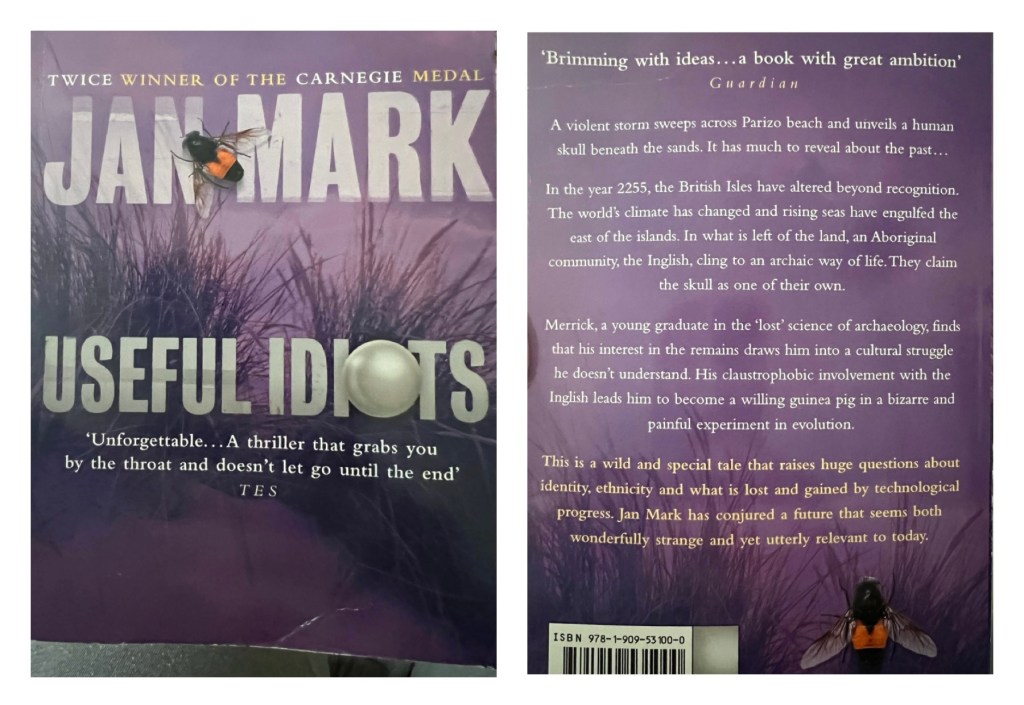
Having mostly read short stories in previous #janMARKuary Januarys, I am starting with a novel this time, Useful Idiots. I will read a chapter a day for 13 days then chose something else.
1st January
I want to focus on Jan’s vocabulary choices and the descriptive images she creates and enhances with the use of one or two extremely well appointed words.
glistened oilily – even saying the word oilily out loud adds texture to the description.
the scything wind – no added comments needed here, we all know what this feels like.
“the auditorium…was raked, with long curving rows of seats” – typing this made me think Jan is linking human made structures with the land and fits in with other imagery and word choices in the text so far.
plastered maquillage (I had to look that up) – there is a passage later in the chapter that builds on this, that shows how caked on the stage make up was.
obdurately blank – Jan uses this phrase to describe a screen wall in a theatre, conjuring audience impatience for the show to start.
city canyons – appears in the middle of a description of a landscape ravaged by a hurricane. I immediately imagined a sweeping view from a drone flying over/down the streets of a very build up urban landscape.
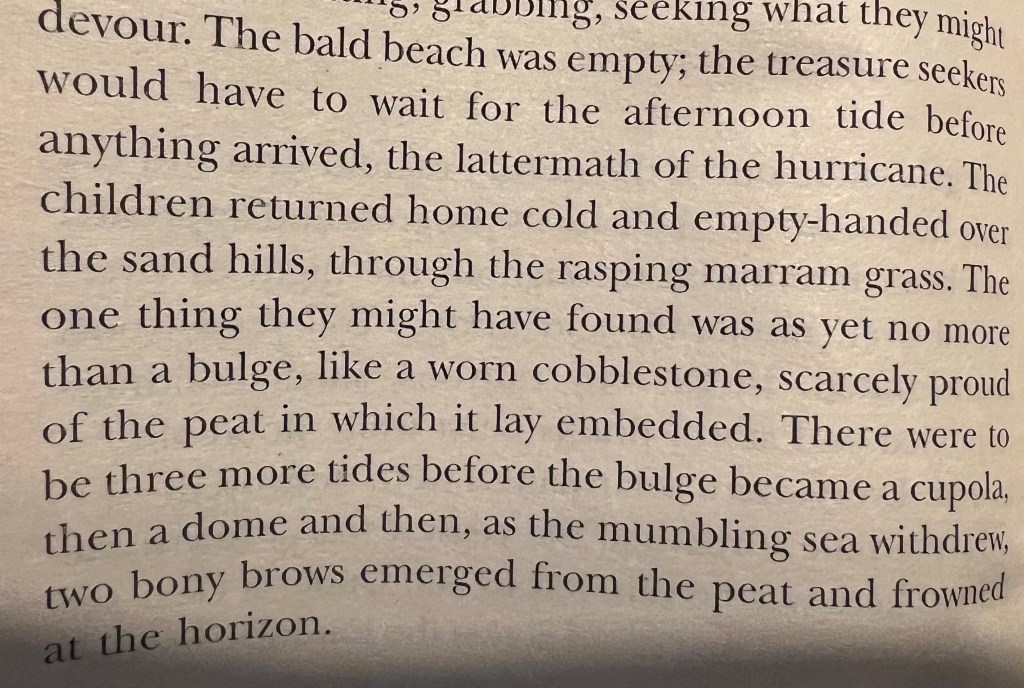
“lattermath of the hurricane” feels like it should jar, but it doesn’t. The dictionary definition refers to the second mowing of a crop. Jan has used it to detail something buried in the sand, “scarcely proud”, that would be further exposed once a second tide had ebbed and flowed. Here is the full paragraph is all its glory.
Archaeology is key to this story and Jan’s phrasing and word play is wonderful. She describes the work of the archeologists as cutting “into their past through a layer cake of centuries”.
Buildings are falling or being dismantled (reasons not yet known) and new builds will be erected, pinning down the past”.
2nd January
The second chapter gives us more details about cultural tensions, the uncovered skull being discovered close to or on the unmarked border between territories. I will look at this as we go further into the story and get more detail.
However, I want to look at the tension between two characters today: Merrick Korda, a graduate trainee, and his archaeologist boss Remy Turcat. So far, we see this from Merrick’s point of view, but it tells us a lot about Turcat’s character. It is unclear if the tension is purely a power one based on position in the organisation or if there are other things at play.
Is Merrick one of the useful idiots of the title? This is not clear yet. But Turcat definitely treats him like an inferior being. Jan describes this all too familiar treatment well, also reflecting the wider cultural tensions, not just that between the two individuals.
“Turcat had neither welcomed him nor turned him away: he was expected.”
“He regarded Korda as little as his own shadow: it was always there beneath him; he did not expect it to speak.”
“…validating Merrick’s suggestion by appropriating it.”
“Turcat looked across at Merrick and had to acknowledge him.”
“He was used to being invisible but not so invisible that he was forgotten.”
There is a definite sense of othering going on from a position of privilege.
3rd January
As the skeleton discovered on the beach is unveiled, slowly, layer by layer from the peat surrounding it, so Jan cleverly reveals the layers of cultural mistrust, misappropriation and history behind the conflict between the indigenous, “archaic” Inglish and the others (so far no name has been attached to them).
Despite Turcat’s dismissive attitude towards Merrick, when it is revealed that he is descended from the Inglish, although he has neither lived in their territories nor followed their lifestyles, Turcat is surprised. This leads me to believe his othering and unbotheredness of Merrick has, up to this point been down to position and privilege. Their boss, on the other hand is downright racist and does not hide it, once Merrick’s ancestry has been voiced aloud.
The way Jan has written the two narratives as one, unpeeling layers to get us to the truth of the matter, is highly skilled and a testament to her skills as a writer.
4th January
Merrick is told to get lost for a couple of days by his boss. He gets on the wrong train and ends up being manipulated into visiting the fen land of the Inglish by someone he has only met once, by chance. The manipulation is subtle and well executed considering it was a chance encounter.
10th January
I finished quicker than anticipated as I was so drawn into the story I could not limit to one chapter a day.
Even though written in 2004, a lot of what Jan has written in here is relevant today: unions, riots, suppression of indigenous people.
The useful idiots of the title are the general population, manipulated into certain behaviours by the media and rich business people with agendas of their own to achieve their goals. Merrick is also a useful idiot, both to Turcat and to the Aboriginals, even more so with the decision he makes without their knowledge.
I had to check the definition of Aboriginal, as Jan chose it to define the indigenous people of Europe, not something I was familiar with.
My understanding/knowledge of the words is in reference to the indigenous people of Australia. The other definition is not place specific: The aboriginal people or animals of a place are ones that have been there from the earliest known times or that were there before people or animals from other countries arrived.
Manipulation is a strong theme running through this story. Manipulation of university departments and staff, protestors, the general public, the indigenous population individuals and in Merrick’s case, his own body. The reasons for, and outcomes of, the manipulation are different in each case and the outcomes not all what was anticipated.
Although described as a YA novel, this presents more as an adult read. I cannot quite put my finger on why. It is definitely not an MG. All the characters are adults. There is no reason it could not be a YA, the themes and content are appropriate and suitable for YA discussion and interpretation.



 Beth's Bookcase