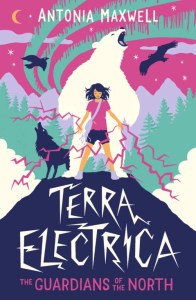
The last ice cap has melted, and the world is on the brink of collapse. A deadly force—Terra Electrica—has been unleashed. It feeds on electricity. It is infecting civilization.
In this chaotic, rapidly changing reality, 12-year-old Mani has lost her family and community to the Terra Electrica. Armed only with some ancestral wisdom and a powerful, ancient wooden mask she was never meant to inherit so soon, she suddenly finds herself responsible for the fate of the world.
Can Mani piece everything together and harness her newfound powers in time to save humanity?
Review
Mani’s father has left her in a cave whilst he goes to find food. He has not returned a month later so she is forced to leave the cave to find something to eat and look for him. She comes across the research centre and one scientist but she has been told they are the enemy and dangerous. What should she do?
She decides she has to interact with the scientist to survive. He has food and shelter. She then discovers she is infected by the deadly force that has killed so many, including her mother. Why is she not ill, or dead? Can she trust the scientist who says he will help her find her father or is his objective much more sinister?
Mani decides to try on the mask she has brought with her. Why did she feel she had to bring it? It is not essential to her survival. Or is it? When she puts it on, she has visions and meets some spirit animals who try to guide her. Frustratingly for Mani, they are not good at answering her direct questions but make her ask even more questions and give her lots to think about. She has a lot to learn about herself and the world.
She uses all her understanding of her people’s stories and traditions to help her work out what she needs to do.
Antonia’s writing carries powerful messages. There is power in stories, beliefs and traditions handed down through generations but there are also those who are selfish and/or greedy and would try to gain personally from something that could help everyone. However, there is always hope.
Thank you to Neem Tree Press and @The_WriteReads for the ARC in exchange for this review.
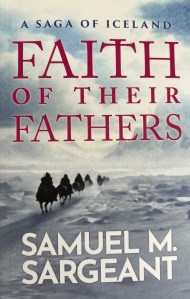
At the dawn of the 10th Century in a small Icelandic settlement, these words, daubed in blood, herald the arrival of a killer.
Soon, a spate of murders threatens the fragile peace between pagans and a growing Christian minority. Arinbjorn, a young pagan farmer resolves to track down the killer before the community is permanently torn apart. His investigations will draw in Freya, an isolated housewife whose secrets could either condemn or free her.
Meanwhile in Norway, King Olaf Tryggvason has his own designs upon Iceland and its people. War is rife in Scandinavia, and a Christian Iceland would bolster his control over the region.
Only one thing is certain: these murders will change Icelandic society forever.
Review
Considering that I love historical sagas and devour television series like Vikings and The Last Kingdom, I rarely read them. Faith of their Fathers piqued my interest and has very much tempted me to right this wrong and read more of them.
Unlike the sagas mentioned above, Faith of their Fathers focusses not on violent invasions or raids, but on the farming and trading population in a small settlement in Iceland, whilst still encompassing the desire for rulers to expand their power bases.
The King of Norway’s priest has been sent to convert the Icelanders to Christianity, but he is not converting as many as the King wants/needs. How can he speed up the conversion rate and also keep the peace between the newly baptised Christians and the majority who still worship the Old Gods? How will the murder of a Christian family impact on his work?
The author, using historical events to centre the story, describes life for these Icelanders clearly and the characters are fully formed and believable. There are explicitly violent scenes, as was the way of things at that time, with religion being used as an excuse for violence to convince one side or the other that their way is the right way way, their god is the right god. However, they do not take away from what is a well crafted, character led story.
As was also the way at that time, it is mostly the men who feature in this story, although the women who do, Freya, Bera and Tyra, are strong and perceptive, making the most of their circumstances and opportunities to influence the actions of the men they love and care for. Freya is particularly strong willed and influential.
Thanks to Neem Tree Press and @The_WriteReads for the ARC to review for this blog tour.
Zohaib, Misha and Nadia believed they would be in each other’s lives forever. As children they played, argued, teased and loved one another. Yet nothing could have prepared them for the tragic turn of events one fateful afternoon in Karachi, Pakistan, when the divisions and differences between them are revealed.
Years later and they are still trying to piece their lives back together, still trying to make sense of what happened. Zohaib is living in London, haunted by the ghosts of the past. Nadia has escaped the household where she first met Misha and Zohaib but finds fate delivering her back to their door…
The Idle Stance of the Tippler Pigeon is a beautifully rendered portrait of love, healing, and long-buried pain, digging deep into the nature of trauma and class division.
Review
I was intrigued by the title of this book, and it engaged me enough to want to read and review it, despite it not being my usual type of read. I am very glad I made that decision. Without spoilers, the title is part of something the father of Misha and Zohaib says to them when they are children, and relates perfectly to the character arcs of both Nadia and Zohaib.
It took me a few chapters to get my head round the format and story, by then I didn’t want to put it down.
Dealing with family, friendship, love, loss, grief and class, this story of the long lasting effects of a childhood trauma, told from multiple perspectives, will stay with me.
The story unfolds mainly via the three main characters, Nadia, Misha and Zohaib, and is set both in the present and 17 years earlier, when Nadia and Misha are about 8. These are interspersed with chapters from the point of view of several other family members which add effectively to the narrative.
We do not find out exactly what happened until the end of the book, but hints are drip fed throughout, whilst we hear about how the event affected those involved as they dealt with it…or not, in some cases.
Despite the themes of poverty vs privilege, domestic violence, mysogyny, grief and mental health issues, there is hope in this story.
The ending (not the reveal of the childhood trauma event, but where the characters are in their lives and relationships) leaves the reader with a lot to contemplate. It is not what I expected but is reflective of reality, in my opinion.
Thank you to Neem Tree Press and @The_WriteReads for a copy of the book for me to review as part of this blog tour.
1798: A magical, dark adventure. Fourteen-year-old Pâtca, initiated in the occult arts, comes to Bucharest, to her uncle, Cuviosu Zăval, to retrieve the Book of Perilous Dishes. The recipes in this magical book can bring about damaging sincerity, forgetfulness, the gift of prediction, or hysterical laughter. She finds her uncle murdered and the book missing. All that Zăval has left her is a strange map she must decipher. Travelling from Romania to France and on to Germany to do so, Pâtca’s family’s true past and powers are revealed, as is her connection to the famous and sublime chef, Silica.
Review
As I read this story, it reminded me very much of folk tales, tales of magic, mystery, spells and intrigue with moralistic threads running through. As with traditional folk tales, this story carries with it warnings that things are not always as they seem, especially when you only have one viewpoint, the MC. People and events can be linked together without you/they realising how until much later, in some cases too late, and there are consequences (mostly unintentional) to actions taken or spells cast (or recipes made, in the case of this story).
When the cook gets hold of the perilous recipes and starts cooking and feeding the prince, he has no idea what mayhem and madness will ensue as he has not been taught about portions or scale, and in most cases he has no clue what the recipes are spells for. As such, it is often the population of the city, not just the prince, that is caught up in the consequences.
Based on historical events around the time of the French Revolution, the story, told from the point of view of Pâtca, a thirteen year old orphan raised by a witch, takes us on a wild ride as her grandmother is arrested and her great uncle murdered. She tries to find out who killed him as well as follow their advice and instructions to the best of her ability. This does not go to plan and she ends up being accused of her great uncle’s murder, suspecting many others, getting herself in trouble and trying to piece together what she knows, what she needs to do and who she can trust.
It did take me a couple of chapters to get my head round what was happening, mainly due to the dual timeline. The author always cut back to 30 years previously just as we were about to learn something of importance. This kept me on my toes and saying “just one more chapter” to myself.
With themes of folklore, heritage, the occult, herbal magic and cultural exploration, this is a murder mystery like no other.
As the story is told from 14 year old Pâtca’s point of view, much of her detective work is done with a tbsp of assumption, a pinch of knowledge, a tsp of information and a drop of life experience, making her version feel unreliable. This is brought together in the final chapter, when the missing pieces of the story are added in by one of the other characters.
Thanks to the publishers, Neem Tree Press, and @The_WriteReads for the eARC in exchange for this review.
The Roman Empire never fell. The Gods are real. Ships are alive.
In the Province of Britannia, ruled by descendants of King Arthur and on the brink of an industrial revolution, young Maia Abella is on the run.
Something unseen has murdered her cruel mistress and she’s being blamed. The streets and factories of Portus are no place for a friendless girl, trapped in events beyond her control.
The city authorities and the Royal Navy are both desperate to find her – one investigating a killer, the other to recruit her, while the deadly legacy of a tragic past stalks her every step.
Aided by Raven, an ancient, blind Mage with a terrible secret and Milo, Crown Agent and spy, Maia must discover and overcome the fatal consequences of her birth.
Meanwhile, the Gods are making their moves. And not all of them are friendly.
Review
Wow. For the first in a series (Ships of Britannia) this absolutely blew me away. This is steeped in Roman mythology, a steampunk fantasy that has Roman Gods running amok, with Maia, a servant girl who is only trying to earn her freedom from her abusive employer, caught up in their power games.
The job of the first book in a series is to set the scene and introduce us to the characters, build the world and kick off the adventure. This is one of the best first books I have read.
Many first books feel slow as they describe the world and this impacts pace. E.M. Kkoulla has managed to do it in such a way that does not slow down the action or take away from plot development. There is a lot of “show, not tell”, which keeps the pace going and interest piqued. Refreshing.
The multi layering of the story is well executed, and small hints are revisited throughout, with reveals that bring the whole thing together.
The world building is superb and the idea of living ships that communicate with each other in their minds is both intriguing and something that I have not come across before.
I am invested in this series and will definitely be reading the follow up books.
Meet Luke Archer, a British Egyptian doctor who struggles to be from two worlds at the same time. He’s working in one of the world’s most dangerous hospitals in Yemen. When rebel forces take over the city, a group of Western mercenaries take refuge inside the hospital and Luke and his team find themselves in the middle of a deadly clash. To make matters worse, leading the mercenaries is an unwelcome figure from Luke’s past. After years saving the lives of others, Luke needs to face the demons of his past in order to save his own.
Set in the UK and Yemen, Guns and Almond Milk is a literary thriller that deals with identity, diversity and old coins of arguable value. It’s The Sympathizer mixed with M.A.S.H by the way of Ramy.
Review
I was unsure what I expected from this but what I got was a fast paced, fairly graphic story with dry, gallows humour, of medics treating soldiers in war torn Yemen, with the intriguing back story of two of the characters, who find themselves reunited in siege circumstances as the hospital comes under sustained attack from the rebels.
The back story of Adam/Luke and Max was not what I expected. What could a first time volunteer medic and a mercenary possibly have been involved in together in the past? Sorry, no spoilers.
Besides the obvious war theme, the other main theme is that of names and identity. Yes…the age old “but where are you really from” question.
An interesting and thought provoking read.
Thank you to the author and @The_WriteReads for the eARC for the purposes of this review.
Historical fiction meets crime fiction in The Djinn’s Apple, an award-winning YA murder mystery set in the Abbasid period—the golden age of Baghdad.
A ruthless murder. A magical herb. A mysterious manuscript.
When Nardeen’s home is stormed by angry men frantically in search of something—or someone—she is the only one who manages to escape. And after the rest of her family is left behind and murdered, Nardeen sets out on an unyielding mission to bring her family’s killers to justice, regardless of the cost…
Full of mystery and mayhem, The Djinn’s Apple is perfect for fans of Arabian Nights, City of Brass, and The Wrath and the Dawn.
Review
Set in 9th century Baghdad, the story follows Nardeen, first as she escapes the political, violent murder of her family and then as a teenager mentored by an eminent doctor. Both her father and her mentor see her potential in what is culturally a male dominated field, which grates with most others.
The story is a well told, and superbly translated, blend of politics, medicine and magic, with Nardeen trying to find answers to her why her family were massacred and look forward to growing into adulthood. She is taken in by her mentor and only after a message from someone else does she question his motives. It is difficult for her to view him as anything other than a trusted mentor until she uncovers more about the politics and reasons behind her family’s murder and his duplicitous behaviour.
I have not read anything set in this time period before and enjoyed finding out more.
The themes of political turmoil, trust, feminism, grief and family secrets are well handled and will promote a lot of discussion and debate.
Thanks to Neem Tree Press and The Write Reads for an ARC for the purposes of this blog tour review.
For wolf-demon Kari, these define her every waking moment. Her parents are dead, slaughtered by human hands, forcing their only daughter to masquerade among their killers to save her own skin. Now she dwells among them, hiding her lightning-based abilities and plotting a terrible revenge, believing her schemes are all she’s good for now. But when she discovers unexpected solace among a group of humans who look past her monstrous nature, Kari finds herself questioning everything. Her mission. Her dreams. Even the hatred festering in her heart.
Is it possible for a creature like Kari to find happiness in a world that despises her?
Or will the spectres of her past force her down the path of vengeance in the end?
Review
As I started reading this I did not expect it to affect me as much as it did. It is to the author’s credit that I was pulled into Kari’s world and didn’t want to leave.
Valerie Storm has created an imaginative, dangerous world in which Kari has so much thrown at her from such a young age. This book does not shy away from violence and death, those Kari builds relationships with put in danger because of the power Kari was born with, despite her trying to keep it hidden, and those who are hunting her.
I had to keep reminding myself that Kari was a teenager to explain some of her reactions but she copes extremely well given her limited knowledge of her gift, the way most people treat her and the trauma of loss and separation she suffers. Her feelings of isolation, indecision and need for revenge drive her.
This is not a cosy fantasy story, it is hard hitting and powerful, better for it. It also ends on a twist and cliffhanger like no other.
I thought I was going to have to wait for the next book in the series so was very happy to realise that this was published in 2022 so others in the series are already out. Off to buy them.
Thank you to @The_WriteReads and Shadow Spark Publishing for the review copy.
I am resharing this blog to celebrate the release of the latest and final book in the series.
The Demon Storm series follows Kari Kasente, the wolf demon destined to destroy the world. While battling an innately crueler self, a Shadow Witch intent on controlling her, and a series of other enemies, Kari must learn to trust herself and those around her. Only then can she find her light and save the world.
The final book in the series, Fate of the Storm was released on May 13, 2025.
About the Author
Valerie Storm was raised in Tucson, Arizona. Growing up, she fell in love with everything fantasy. When she wasn’t playing video games, she was writing. By age ten, she began to write her own stories as a way to escape reality. When these stories became a full-length series, she considered the path to sharing with other children & children-at/heart looking for a place to call home.
Meet Zélie Dutta. She has beaten her own father five times at chess (the last time he cheated). She has crushed the head of a poisonous cobra with her naked heel AND she can lick her elbow.
There’s nothing that she can’t handle… or at least that’s what she thinks. But when her father goes missing and a sinister secret society seems to be to blame, she’s forced to look for help in the most unlikely of places…
Swept up in a slew of crimes that stretch from the jungles of Calcutta to the sewers of Paris, Zélie and her new friend Jules begin a desperate hunt for the magical Snakestone at the heart of the conspiracy. Can they solve the ancient riddles and mysteries concealed in the miles of murky tunnels that twist beneath the ancient city above?
Review
It has a book map (said in the same voice as “It has pockets.”).
I thoroughly enjoyed joining Zélie and Jules on their adventures and derring do. Although Jules is more reluctant than Zélie to place himself in danger, he is a good friend and wants to help. He tries to warn her that not everyone should be taken at their word but she ignores his pleas, which puts her in mortal danger more than once. I particularly enjoyed the internal, motivational speeches Zélie gives herself when in need of a bit of extra bravery.
Set in the underbelly of Paris near the end of the 19th century and based on a colonial tale of a healing stone (with severe small print warnings), the story involves family separation and loss, subterfuge, circus acts, a secret society up to no good and a cast of diverse and often dastardly characters.
The main themes are friendship, trust, making the right choice, greed and power.
Thank you to the author for pointing out the absolute truth about pockets (severe lack of) in women’s clothes and the huge issue of back and front fastenings on clothing…how many items of men’s clothing need contortionist skills to fasten them? Exactly!
Thanks to NetGalley and Nosy Crow for the eARC in exchange for this review. The book will be published on March 14th 2024.
Queen Clytemnestra’s world shatters when Agamemnon, a rival to the throne of Mycenae, storms her palace, destroys her family and claims not only the throne but Clytemnestra herself.
Tormented by her loss, she vows to do all she can to protect the children born from her unhappy marriage to Agamemnon. But when her husband casts his ruthless gaze towards the wealthy citadel of Troy, his ambitions threaten, once more, to destroy the family Clytemnestra loves.
From one of Greek mythology’s most reviled characters—a woman who challenged the absolute power of men—comes this fiery tale of power, family rivalry and a mother’s burning love.
Review
Going into this, the only retelling of the Greek myths I had read recently was Jessie Burton’s Medusa (which I reviewed here) so was unsure how I would find it. From my memory of Greek myths read as a child, I knew of Clytemnestra as Agamemnon’s wife and murderer, so was expecting that to be the story. However…
Susan C. Wilson takes us right back to just before Clytemnestra even meets Agamemnon, before he claims her as his wife and Queen, having been on a murderous rampage against her family to reclaim the throne he says is rightfully his. This enables us, through Clytemnestra’s eyes, to discover what brought her to the point of murdering her husband.
Clytemnestra, bizarrely for this era, decides not to seek vengeance for her murdered family, but to be his wife and put up with his vile attitudes, behaviour, ego, and general misogyny.
This part of her story is told by Clytemnestra herself, and the main focus is on her and the children, her love for them and her aim to protect them from their father. Only time would tell if this was the right thing to do or whether they would suffer because of her choices.
The children grew up with differing relationships with both Clytemnestra and Agamemnon, the latter’s mysogyny meaning Orestes (son) was favoured heavily from birth, the older girls, Iphigenia and Electra, being dismissed offhand. Despite Clytemnestra’s best efforts, Electra, a daddy’s girl, suffered the most from his dismissive attitude. Orestes and Electra shock their mother when they take their father’s side on a heartbreaking event later in the story.
All the way through this story, my thoughts were on how much danger women were in at all times, in those days. Just to survive, never mind thrive.
“She might be a poor farm wife and I a queen, but our similarities weren’t lost on me. We were pieces on a gaming board to be claimed, manoeuvred, and discarded by men. Rich or poor, famous or obscure, men made the rules that ordered our lives, and they broke them. She and I were women.
Clytemnestra puts her children first, above herself, and tries to instill “appropriate” female behaviour and attitudes inher daughters, mainly to protect them from their father’s wrath. Electra is having none of it, cannot understand why she cannot dress like her brother, go hunting and be trained in fighting skills as he is. Clytemnestra is blamed by Agamemnon for not bringing her up properly, Electra seeing her as a failure for not standing up to him over her upbringing.
Another theme I kept thinking about is that history is written by the winners. Throughout this book, different versions of the same events are told by people from different sides, or with a different viewpoint, having been involved in some way. Agamemnon’s victory over Clytemnestra’s family was joyous for him, heartbreaking for her. The same event, different viewpoints…both the truth… to the teller.
Agamemnon tells many stories in which he is the righteous winner (obviously) but pretty soon, Clytemnestra learns to mistrust everything he says and also wonder about the things he doesn’t say. It also means she mistrusts what anyone tells her, seeking verification from others.
There are so many familial links in the Greek timeline, so much to keep track of and I was glad of the family tree at the start as I needed to refer to it a fair bit. Even so, the power grabs made by all sides at different times resulted in many incestuous relationships, one of them being the last straw for Clytemnestra, making her decide the time had come to end Agamemnon.
Despite knowing more about what comes next, I will still be intrigued to read the next book in this series, as it is so well written.
Thanks to Neem Tree Press and @The_WriteReads for the ARC in order to take part in this blog tour.



 Beth's Bookcase