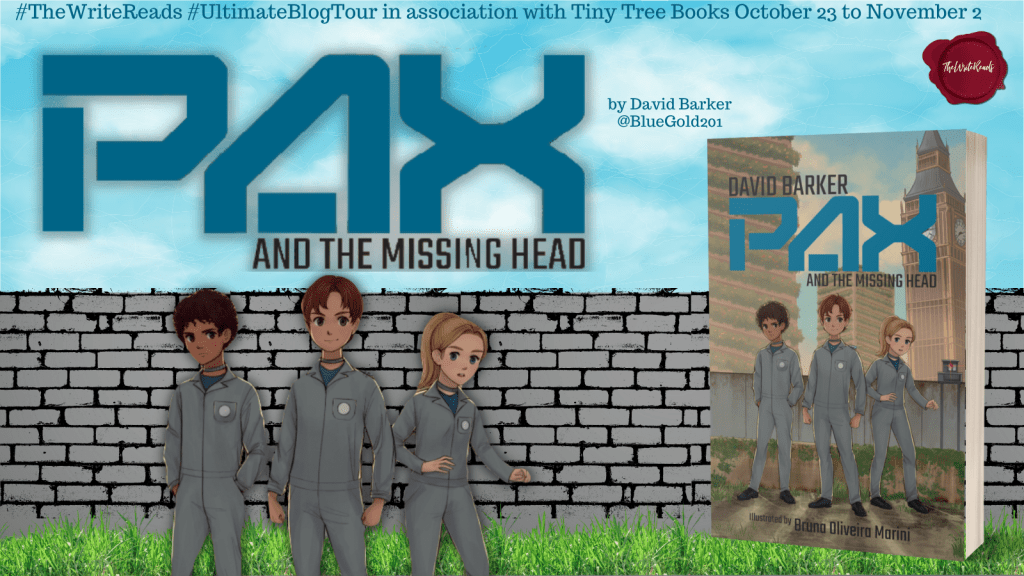
In a country beset by civil war, New London defends itself behind a giant wall. Inside the city, children are forced to work from am early age, except for the lucky few who train to be leaders in the re-purposed Palace of Westminster. 12-year-old orphaned Pax is brilliant at recycling old tech. He enjoys working on the verti-farms and just wants a bit of peace and quiet. But when that is taken away from him, his only hope is to pass a near impossible exam and join the other students in Scholastic Parliament. There he’ll make new friends and new enemies. He’ll get tested like never before. And he’ll discover that not everything is quite what it seems under the mayor’s harsh leadership.
Review
David Barker has created a dystopian future of walled cities where the young, poor live, either working or, for a select few who pass an exam, being educated to be future leaders. Outside those walls are the Countryside Alliance, where all the rich, older residents live. The two groups are at war and will stop at nothing to win.
Pax is a seedling, created as a worker, so has no parents. Alderman, the AI overseer, spots his intelligence and potential, especially in engineering and encourages him to apply for the school exam. Pax has no family to ground him or build up his self belief which means he constantly questions his own abilities.
How will he get on when a powerful someone does not want him to pass? If he does pass, will he make friends and fulfil his dream of becoming an engineer who fixes things to make life easier for others?
There are themes of friendship, bullying, war, dictatorship and doing the right thing.
I really enjoyed this book. There are a few red herrings, a couple of which I fell for, unusually for me, and there was the right amount of tension building. I liked the way Pax went about problem solving, using his skills in building robotic creatures from tech scraps to help him and his friends.
This is David Barker’s first MG book, although he has written for adults previously, and I look forward to his next one.
Thank you to @TinyTreeBooks and @The_WriteReads for the ARC.
Having read and enjoyed Stuart’s MG novel, Ghosts of Mars, earlier this year, I was intrigued to read his latest YA dystopian novel.
Blurb
IN A NAMELESS WORLD, ONE HERO RISES BY DISCOVERING THEIR IDENTITY.
In a dystopian world dominated by genetic perfection and numbered gene pools, sixteen-year-old E820907, known as Seven, yearns for an identity beyond his assigned number.
To escape a life as a Nameless Exile, and become a citizen of the Realm, he must pass a loyalty test to prove his allegiance to the totalitarian Autokratōr.
With the world’s fate hanging in the balance, Seven’s journey sparks rebellion, hope, and the reclamation of individuality.
But as the truth unfolds, Seven faces a difficult choice between revenge and love.
Review
Stuart White has created a disconcertingly possible future world, where a dictator demands obedience and service. Children are trained and placed in the area of their strength (military, science, environment) to further the realm. Those who do not meet the standard are discarded from the walled city and left to their own devices and at the mercy of the other Nameless groups out there, some of which have turned brutally cruel, without an identity.
This obviously leads to rebellion, spies, treason and war.
Seven sits the tests … but will he ever find out who he is, who his parents are, why his foster mum protects him and refuses to answer his questions? Full of self doubt, fear and infinite questions that he frustratingly rarely gets full answers to, his journey takes him to places he never imagined, meeting people he didn’t even know existed, making him decide where his loyalties lie, despite knowing very little about the sides he is choosing between.
He also struggles with his purpose. Is it to protect his friends or lead a group who resent him? Will his impetuous decision making put him and others in even more danger? Will his training help or hinder him?
I recommend reading to find out the answers to all these questions. The author leaves us with some of the story resolved but waiting in expectation for Book 2 to take Seven’s journey on further. As a reader, this made me sympathise with Seven, not getting all the answers to my questions straight away! I look forward to accompanying him on his next chapter.
Trigger warning: this book is not for the faint hearted, it is bloody and involves torture.
Thanks to @StuartWhiteWM and @The_WriteReads for the eARC.
Yes, it is another Victoria Williamson book, I am quite the fan. This time Victoria moves from MG to a dystopian adventure for a YA audience. I am long past YA status, but as with her children’s books, adults will enjoy this too.
Blurb
The Earth’s ecosystems have collapsed and only ashes remain. Is one girl’s courage enough to keep hope alive in the wastelands?
It’s the year 2123, and sixteen-year-old Adina has just accidentally killed fourteen thousand seven hundred and fifty-six people.
Raised in the eco-bubble of Eden Five, Adina has always believed that the Amonston Corporation’s giant greenhouse would keep her safe forever. But when her own careless mistake leads to an explosion that incinerates Eden Five, she and a small group of survivors must brave the barren wastelands outside the ruined Dome to reach the Sanctuary before their biofilters give out and their DNA threatens to mutate in the toxic air.
They soon discover that the outside isn’t as deserted as they were made to believe, and the truth is unearthed on their dangerous expedition. As time runs out, Adina must tackle her guilty conscience and find the courage to get everyone to safety. Will she make it alive, or will the Nomalies get to her first?
Review
The author has created an unfortunately believable future world caused by corporate greed and subsequent cover ups at global government level, but at the heart of this story are the relationships between the various characters. Their personalities and character lead the narrative, as they struggle to survive and reach safety.
Like a typical teenager, Adina has her own agenda. Whilst she is intelligent and good at her job as a technician in the Dome, helping to keep the machinery working, she is often distracted from this by other tasks she would rather be doing which, as expected, are not aligned with her responsibilities and lead her into trouble more often than not. She fully justifies her decisions to herself, she sees them as benefitting others, not herself, but they ultimately lead to her taking responsibility for the destruction of the dome and the deaths of all but a few occupants. Keeping this a secret from her best friend, Dejen, and the other survivors means her relationship with them becomes strained as she pushes them away to stop them working it out.
As I have said in a previous blog, books are either mirrors or windows for the reader. Most of this book was a window for me given the futuristic setting, but Adina’s conscience and the projection of her fears onto her perception of the reasons others look at her as they do is a mirror for my own. No, I have not accidentally (or even deliberately) killed thousands, but her feelings of guilt and how she perceives what others think about her and her actions rings true for me. I often make more of something in my head then find out I needn’t have. Moral of this…talk to people, don’t keep feelings internalised.
Once again, Williamson is not afraid to cover many big issues in her writing. In Feast of Ashes these include keeping secrets, family disfunction, global corporate greed that impacts on the people and eco systems in Africa, government secrets, death and making sacrifices.
This is the first of a series and I look forward to the next instalment.
This is not going to be a normal review post. I am joining Ben Harris (@one_to_read) and others on Twitter this month to celebrate the work of Jan Mark. I will add to the blog (not promising it will be daily) on my readings over the month. They are more notes than a narrative. I apologise in advance if they seem disjointed, I am finding new links as I read and type these. I may return to previous days and add/edit as I read further.
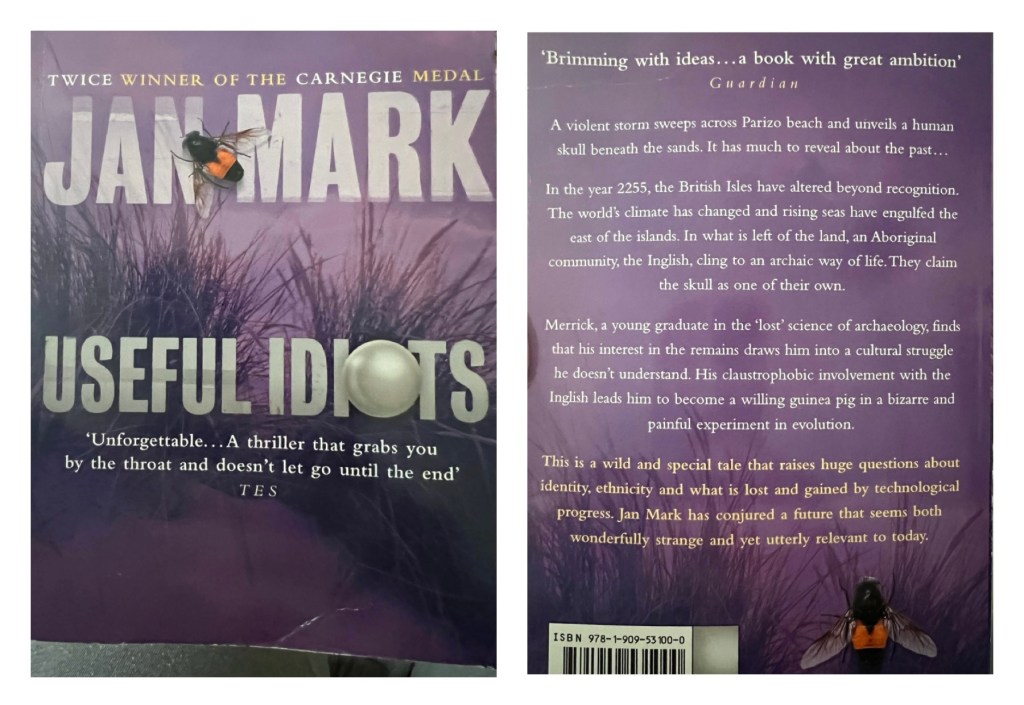
Having mostly read short stories in previous #janMARKuary Januarys, I am starting with a novel this time, Useful Idiots. I will read a chapter a day for 13 days then chose something else.
1st January
I want to focus on Jan’s vocabulary choices and the descriptive images she creates and enhances with the use of one or two extremely well appointed words.
glistened oilily – even saying the word oilily out loud adds texture to the description.
the scything wind – no added comments needed here, we all know what this feels like.
“the auditorium…was raked, with long curving rows of seats” – typing this made me think Jan is linking human made structures with the land and fits in with other imagery and word choices in the text so far.
plastered maquillage (I had to look that up) – there is a passage later in the chapter that builds on this, that shows how caked on the stage make up was.
obdurately blank – Jan uses this phrase to describe a screen wall in a theatre, conjuring audience impatience for the show to start.
city canyons – appears in the middle of a description of a landscape ravaged by a hurricane. I immediately imagined a sweeping view from a drone flying over/down the streets of a very build up urban landscape.
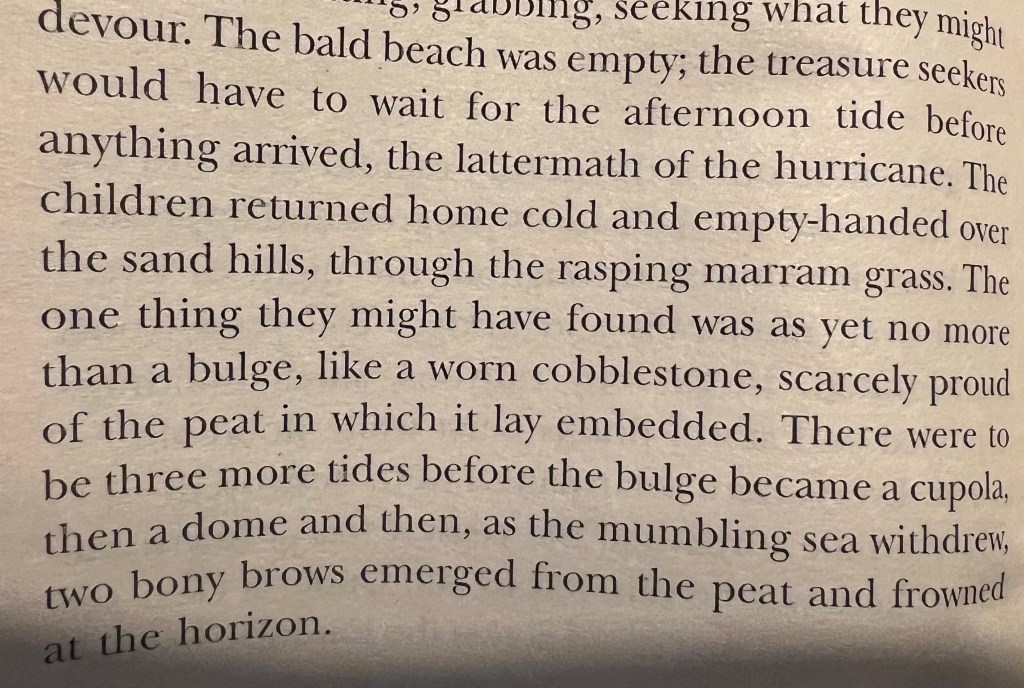
“lattermath of the hurricane” feels like it should jar, but it doesn’t. The dictionary definition refers to the second mowing of a crop. Jan has used it to detail something buried in the sand, “scarcely proud”, that would be further exposed once a second tide had ebbed and flowed. Here is the full paragraph is all its glory.
Archaeology is key to this story and Jan’s phrasing and word play is wonderful. She describes the work of the archeologists as cutting “into their past through a layer cake of centuries”.
Buildings are falling or being dismantled (reasons not yet known) and new builds will be erected, pinning down the past”.
2nd January
The second chapter gives us more details about cultural tensions, the uncovered skull being discovered close to or on the unmarked border between territories. I will look at this as we go further into the story and get more detail.
However, I want to look at the tension between two characters today: Merrick Korda, a graduate trainee, and his archaeologist boss Remy Turcat. So far, we see this from Merrick’s point of view, but it tells us a lot about Turcat’s character. It is unclear if the tension is purely a power one based on position in the organisation or if there are other things at play.
Is Merrick one of the useful idiots of the title? This is not clear yet. But Turcat definitely treats him like an inferior being. Jan describes this all too familiar treatment well, also reflecting the wider cultural tensions, not just that between the two individuals.
“Turcat had neither welcomed him nor turned him away: he was expected.”
“He regarded Korda as little as his own shadow: it was always there beneath him; he did not expect it to speak.”
“…validating Merrick’s suggestion by appropriating it.”
“Turcat looked across at Merrick and had to acknowledge him.”
“He was used to being invisible but not so invisible that he was forgotten.”
There is a definite sense of othering going on from a position of privilege.
3rd January
As the skeleton discovered on the beach is unveiled, slowly, layer by layer from the peat surrounding it, so Jan cleverly reveals the layers of cultural mistrust, misappropriation and history behind the conflict between the indigenous, “archaic” Inglish and the others (so far no name has been attached to them).
Despite Turcat’s dismissive attitude towards Merrick, when it is revealed that he is descended from the Inglish, although he has neither lived in their territories nor followed their lifestyles, Turcat is surprised. This leads me to believe his othering and unbotheredness of Merrick has, up to this point been down to position and privilege. Their boss, on the other hand is downright racist and does not hide it, once Merrick’s ancestry has been voiced aloud.
The way Jan has written the two narratives as one, unpeeling layers to get us to the truth of the matter, is highly skilled and a testament to her skills as a writer.
4th January
Merrick is told to get lost for a couple of days by his boss. He gets on the wrong train and ends up being manipulated into visiting the fen land of the Inglish by someone he has only met once, by chance. The manipulation is subtle and well executed considering it was a chance encounter.
10th January
I finished quicker than anticipated as I was so drawn into the story I could not limit to one chapter a day.
Even though written in 2004, a lot of what Jan has written in here is relevant today: unions, riots, suppression of indigenous people.
The useful idiots of the title are the general population, manipulated into certain behaviours by the media and rich business people with agendas of their own to achieve their goals. Merrick is also a useful idiot, both to Turcat and to the Aboriginals, even more so with the decision he makes without their knowledge.
I had to check the definition of Aboriginal, as Jan chose it to define the indigenous people of Europe, not something I was familiar with.
My understanding/knowledge of the words is in reference to the indigenous people of Australia. The other definition is not place specific: The aboriginal people or animals of a place are ones that have been there from the earliest known times or that were there before people or animals from other countries arrived.
Manipulation is a strong theme running through this story. Manipulation of university departments and staff, protestors, the general public, the indigenous population individuals and in Merrick’s case, his own body. The reasons for, and outcomes of, the manipulation are different in each case and the outcomes not all what was anticipated.
Although described as a YA novel, this presents more as an adult read. I cannot quite put my finger on why. It is definitely not an MG. All the characters are adults. There is no reason it could not be a YA, the themes and content are appropriate and suitable for YA discussion and interpretation.




 Beth's Bookcase