A fast-paced, high-kicking debut that’s Crouching Tiger, Hidden Dragon meets Stand Up, Yumi Chung as a young taekwondo artist uses an ancient book to help save her dreams—and her father.
Twelve-year-old Modesty “Mo” Seto dreams of being a taekwondo champion. Even though her mom disapproves, Mo can always count on her dad, who is her number one fan and biggest supporter. Lately, Mo has been on a losing streak, and it doesn’t help that she keeps losing to her archnemesis, Dax, who’s much bigger than her. If only she were faster, stronger, not so petite. Mo can’t even lean on her dad like usual with how distracted he’s been lately.
When Mo learns about the chance to audition to star alongside her idol and legendary martial artist and movie star Cody Kwok, she knows this her chance to prove to her dad, to the world, and to herself that she can compete with anyone, no matter her size. Unfortunately, Dax is auditioning, too. As Mo and her nemesis progress to callbacks, someone attempts to sabotage the movie set and Mo’s dad disappears—and both events seem linked to a mysterious book, the Book of Joy.
Review
“Though she be but little she is fierce” and “never meet your heroes” sum this book up perfectly.
Mo has to use all her cunning and creativity when not only is her father mysteriously AWOL but accidents seem to follow her around.
When she finds an ancient book that she cannot understand but knows links her family to an ancient discipline she so wants to understand and practice, she has to put her feelings of inadequacy due to her lack of height as well as her disappointment at the less than heroic leading man aside and prove to everyone around her that she has what it takes to solve the mysteries going on around her.
The themes of family, inner strength and self belief drive this pacey MG thriller, with its varied cast of characters and a feisty, gritty, determined, rule-busting protagonist.
Thanks to Simon & Schuster and @The_WriteReads for the eARC in exchange for this review on the blog tour.
Meet Zélie Dutta. She has beaten her own father five times at chess (the last time he cheated). She has crushed the head of a poisonous cobra with her naked heel AND she can lick her elbow.
There’s nothing that she can’t handle… or at least that’s what she thinks. But when her father goes missing and a sinister secret society seems to be to blame, she’s forced to look for help in the most unlikely of places…
Swept up in a slew of crimes that stretch from the jungles of Calcutta to the sewers of Paris, Zélie and her new friend Jules begin a desperate hunt for the magical Snakestone at the heart of the conspiracy. Can they solve the ancient riddles and mysteries concealed in the miles of murky tunnels that twist beneath the ancient city above?
Review
It has a book map (said in the same voice as “It has pockets.”).
I thoroughly enjoyed joining Zélie and Jules on their adventures and derring do. Although Jules is more reluctant than Zélie to place himself in danger, he is a good friend and wants to help. He tries to warn her that not everyone should be taken at their word but she ignores his pleas, which puts her in mortal danger more than once. I particularly enjoyed the internal, motivational speeches Zélie gives herself when in need of a bit of extra bravery.
Set in the underbelly of Paris near the end of the 19th century and based on a colonial tale of a healing stone (with severe small print warnings), the story involves family separation and loss, subterfuge, circus acts, a secret society up to no good and a cast of diverse and often dastardly characters.
The main themes are friendship, trust, making the right choice, greed and power.
Thank you to the author for pointing out the absolute truth about pockets (severe lack of) in women’s clothes and the huge issue of back and front fastenings on clothing…how many items of men’s clothing need contortionist skills to fasten them? Exactly!
Thanks to NetGalley and Nosy Crow for the eARC in exchange for this review. The book will be published on March 14th 2024.
Queen Clytemnestra’s world shatters when Agamemnon, a rival to the throne of Mycenae, storms her palace, destroys her family and claims not only the throne but Clytemnestra herself.
Tormented by her loss, she vows to do all she can to protect the children born from her unhappy marriage to Agamemnon. But when her husband casts his ruthless gaze towards the wealthy citadel of Troy, his ambitions threaten, once more, to destroy the family Clytemnestra loves.
From one of Greek mythology’s most reviled characters—a woman who challenged the absolute power of men—comes this fiery tale of power, family rivalry and a mother’s burning love.
Review
Going into this, the only retelling of the Greek myths I had read recently was Jessie Burton’s Medusa (which I reviewed here) so was unsure how I would find it. From my memory of Greek myths read as a child, I knew of Clytemnestra as Agamemnon’s wife and murderer, so was expecting that to be the story. However…
Susan C. Wilson takes us right back to just before Clytemnestra even meets Agamemnon, before he claims her as his wife and Queen, having been on a murderous rampage against her family to reclaim the throne he says is rightfully his. This enables us, through Clytemnestra’s eyes, to discover what brought her to the point of murdering her husband.
Clytemnestra, bizarrely for this era, decides not to seek vengeance for her murdered family, but to be his wife and put up with his vile attitudes, behaviour, ego, and general misogyny.
This part of her story is told by Clytemnestra herself, and the main focus is on her and the children, her love for them and her aim to protect them from their father. Only time would tell if this was the right thing to do or whether they would suffer because of her choices.
The children grew up with differing relationships with both Clytemnestra and Agamemnon, the latter’s mysogyny meaning Orestes (son) was favoured heavily from birth, the older girls, Iphigenia and Electra, being dismissed offhand. Despite Clytemnestra’s best efforts, Electra, a daddy’s girl, suffered the most from his dismissive attitude. Orestes and Electra shock their mother when they take their father’s side on a heartbreaking event later in the story.
All the way through this story, my thoughts were on how much danger women were in at all times, in those days. Just to survive, never mind thrive.
“She might be a poor farm wife and I a queen, but our similarities weren’t lost on me. We were pieces on a gaming board to be claimed, manoeuvred, and discarded by men. Rich or poor, famous or obscure, men made the rules that ordered our lives, and they broke them. She and I were women.
Clytemnestra puts her children first, above herself, and tries to instill “appropriate” female behaviour and attitudes inher daughters, mainly to protect them from their father’s wrath. Electra is having none of it, cannot understand why she cannot dress like her brother, go hunting and be trained in fighting skills as he is. Clytemnestra is blamed by Agamemnon for not bringing her up properly, Electra seeing her as a failure for not standing up to him over her upbringing.
Another theme I kept thinking about is that history is written by the winners. Throughout this book, different versions of the same events are told by people from different sides, or with a different viewpoint, having been involved in some way. Agamemnon’s victory over Clytemnestra’s family was joyous for him, heartbreaking for her. The same event, different viewpoints…both the truth… to the teller.
Agamemnon tells many stories in which he is the righteous winner (obviously) but pretty soon, Clytemnestra learns to mistrust everything he says and also wonder about the things he doesn’t say. It also means she mistrusts what anyone tells her, seeking verification from others.
There are so many familial links in the Greek timeline, so much to keep track of and I was glad of the family tree at the start as I needed to refer to it a fair bit. Even so, the power grabs made by all sides at different times resulted in many incestuous relationships, one of them being the last straw for Clytemnestra, making her decide the time had come to end Agamemnon.
Despite knowing more about what comes next, I will still be intrigued to read the next book in this series, as it is so well written.
Thanks to Neem Tree Press and @The_WriteReads for the ARC in order to take part in this blog tour.
Yes, it is another Victoria Williamson book, I am quite the fan. This time Victoria moves from MG to a dystopian adventure for a YA audience. I am long past YA status, but as with her children’s books, adults will enjoy this too.
Blurb
The Earth’s ecosystems have collapsed and only ashes remain. Is one girl’s courage enough to keep hope alive in the wastelands?
It’s the year 2123, and sixteen-year-old Adina has just accidentally killed fourteen thousand seven hundred and fifty-six people.
Raised in the eco-bubble of Eden Five, Adina has always believed that the Amonston Corporation’s giant greenhouse would keep her safe forever. But when her own careless mistake leads to an explosion that incinerates Eden Five, she and a small group of survivors must brave the barren wastelands outside the ruined Dome to reach the Sanctuary before their biofilters give out and their DNA threatens to mutate in the toxic air.
They soon discover that the outside isn’t as deserted as they were made to believe, and the truth is unearthed on their dangerous expedition. As time runs out, Adina must tackle her guilty conscience and find the courage to get everyone to safety. Will she make it alive, or will the Nomalies get to her first?
Review
The author has created an unfortunately believable future world caused by corporate greed and subsequent cover ups at global government level, but at the heart of this story are the relationships between the various characters. Their personalities and character lead the narrative, as they struggle to survive and reach safety.
Like a typical teenager, Adina has her own agenda. Whilst she is intelligent and good at her job as a technician in the Dome, helping to keep the machinery working, she is often distracted from this by other tasks she would rather be doing which, as expected, are not aligned with her responsibilities and lead her into trouble more often than not. She fully justifies her decisions to herself, she sees them as benefitting others, not herself, but they ultimately lead to her taking responsibility for the destruction of the dome and the deaths of all but a few occupants. Keeping this a secret from her best friend, Dejen, and the other survivors means her relationship with them becomes strained as she pushes them away to stop them working it out.
As I have said in a previous blog, books are either mirrors or windows for the reader. Most of this book was a window for me given the futuristic setting, but Adina’s conscience and the projection of her fears onto her perception of the reasons others look at her as they do is a mirror for my own. No, I have not accidentally (or even deliberately) killed thousands, but her feelings of guilt and how she perceives what others think about her and her actions rings true for me. I often make more of something in my head then find out I needn’t have. Moral of this…talk to people, don’t keep feelings internalised.
Once again, Williamson is not afraid to cover many big issues in her writing. In Feast of Ashes these include keeping secrets, family disfunction, global corporate greed that impacts on the people and eco systems in Africa, government secrets, death and making sacrifices.
This is the first of a series and I look forward to the next instalment.
MAY, 1910. As the blazing Halley’s comet draws close to the earth, Nancy is uprooted to start a new life in Suffolk with a grandfather she has never met. With every curtain drawn shut, Nancy is forbidden from leaving her grandfather’s house: no one must know that her or her mother are there.
Yet, when Nancy discovers the house’s secret observatory, she watches her mother and grandfather creep out every night… Where are they going? And why mustn’t any of them be seen? Why does the Mayor hate her grandfather? As the mysteries pile up, Nancy has to bring dark secrets from the past to light – even if doing so will put her own life at risk.
A.M. Howell has done it again. A very enjoyable, mysterious, quick-paced adventure with many secrets being revealed to Nancy about her family as she investigates what her mother and grandfather are up to. Some of the secrets she is happy to discover, a couple not so much. The story is about family, the secrets they keep (and the reasons why), trust, power (how not to use it) and standing up for what you know to be the right thing, no matter how difficult it is or who it is you are standing up against. Sometimes you can be surprised by who else will stand with you once you start.
Anyone who knows me, knows I love a map in the front of a book. A.M. Howell doesn’t disappoint, featuring a map of 1910 Bury St. Edmunds as brought to life by Nancy and friends.
I was provided with an eARC of this book by NetGalley and Usborne Publishing. It is published on 8th July 2021.
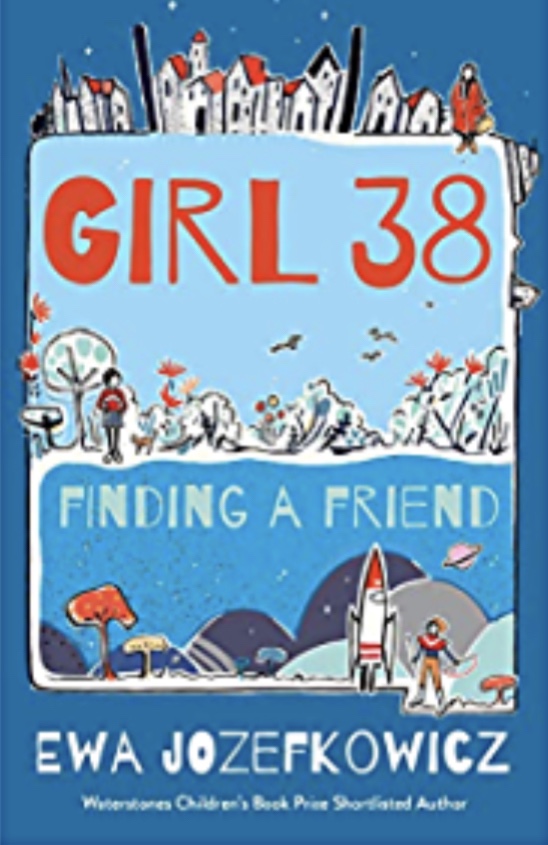
Girl 38 is three stories in one. Kat finds herself, as a teenager, feeling lonely and realising her best friend since nursery is actually very controlling, bullying her into things she does not want to do.
As an escape from this, Kat creates comic strip stories set in the future about Girl 38, a strong, brave character. People in her life provide her with inspiration for the qualities, both good and bad, of the comic strip characters.
At the same time as a new boy joins her school, annoying her best friend, Kat finally meets and begins a friendship with the elderly Polish lady, Ania, who lives next door.
Ania begins to tell Kat about her search for a friend in World War II, a story that includes jumping from a train, sewers and grim determination. Kat, without telling Ania what is happening in her own life at the time, reflects on Ania’s experiences and makes links to her own situation.
As the tale unfolds, will Kat find inspiration and courage from Ania’s experiences to finally stand up for herself? Will she find the right ending for Girl 38?
This is one of those books that has been on my tbr pile for too long. I cannot believe I did not read it before now.
The author deals with the difficult subjects of control, bullying and the occupation of Poland in WWII with aplomb. There are themes of moral courage, bravery, friendship, hope and finding light in the dark, which Ewa Jozefkowicz tackles with a sure touch, enabling the readers to enjoy the story whilst also contemplating the impact people in your life have.
The stylish cover illustration, by Anna Hymas, beautifully depicts the three stories told in the book.
It is 1905. After the death of her mother Helena finds herself moving to Cambridge with her father, a clock maker, and her precious parrot Orbit. Her father has accepted a job in the house of Mr Westcott. The job is a strange one, to keep all the clocks in the house ticking, never letting them stop and to never discuss any strange goings on. Helena finds this bizarre but then discovers other things that deepen her resolve to get to the bottom of the mystery. Just as she works out one puzzle, another one appears.
She befriends Florence, Mr Westcott’s daughter, and Stanley, the only servant left in the house. Together they try to work out why the clocks can never be allowed to stop, why Mr Westcott and his sister, Katherine, do daily clock inspections, what happened to Helena’s father’s predecessor, what is behind Katherine’s mysterious behaviour and why the clock keys disappear.
This is a well paced story with plenty of twists and turns. It also provides plenty of discussion points along the way, including the historical backdrop of the development of flight by the Wright Brothers.
The story has many themes, including loss, grief, superstitions, attitudes to females in engineering/academia at the time and that doing the wrong thing for whatever reason is not going to end well.
It is unusual to find end papers in paperback novels so I was excited to discover this book has them. Saara Söderlund has beautifully illustrated clues to different aspects of the story…clocks, books, hats and feathers.




 Beth's Bookcase