Domino is an eleven-year-old girl with a strange affliction: if she goes anywhere near magic, it will kill her.
All her life she’s been trapped in a floating laboratory, safe from magic but not from the cruel children and the crueler Science Barons who live there. Domino believes the Barons are trying to invent a cure for her magic allergy, but when a mysterious wizard arrives and unleashes total chaos, she discovers that everything she’s been told is a lie.
Domino escapes to the wondrous city of Abzalaymon, its streets filled with marvels she’s never seen, from automobiles to televisions to hulking thunder lizards. But the Science Barons are on her trail, and Domino must brave a hidden realm of magic if she is to defeat their sinister plot, and uncover a secret that might just save the world: the Secret of the Moonshard.
Review
Struan Murray has done it again. A superbly crafted story in a fantastically created world. The Scientarium floats above the city, tormenting Domino, who dreams of visiting it one day, who has known nothing else but the bullying / prankster revenge and testing cycles her life consists of, thanks to the Science Barons who raise her there “to protect her from magic”. Does she really need protecting?
Once again, following the highly original and exciting Orphans of the Tide trilogy, the author has delivered with a variety of well defined characters, twists and turns, magic and mayhem, chases that have you on the edge your seat and even some dinosaurs.
Creating characters with depth and believability is a special skill and Murray has this down to a fine art. The ones that I’m particularly drawn to are those who bring indecision to my mind…which side will these characters fall on when push comes to shove? Abzalaymon, the spirit, is a deliciously contrasting character, which puts you, as the reader, on edge. Will they help Domino, Calvin and Raphael…or eat them?
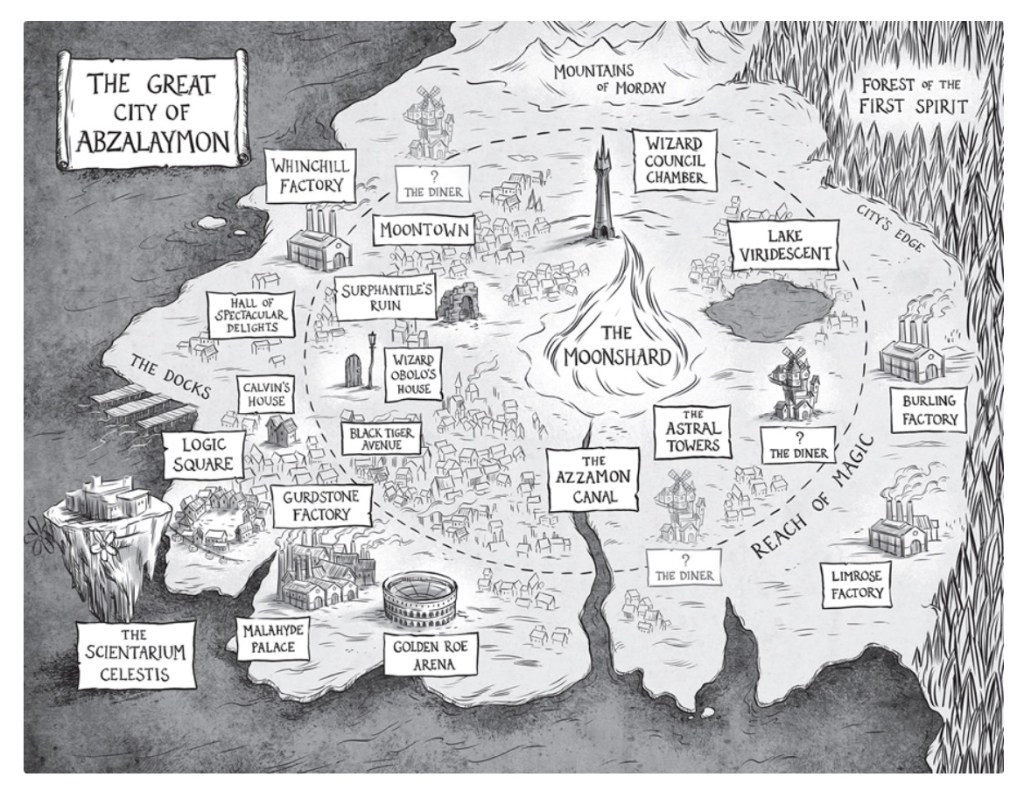
A book map is always a bonus.
Thanks to NetGalley and Puffin for the eARC in exchange for this review. The book will be published on March 7th 2024
A diverse resistance force fights to topple an empire in this vibrant fantasy about freedom, identity and decolonization.
By sinking a fleet of Imperial Warships, the Pirate Supreme and their resistance fighters have struck a massive blow against the Emperor. Now allies from across the empire are readying themselves, hoping against hope to bring about the end of the conquerors’ rule and the rebirth of the Sea. But trust and truth are hard to come by in this complex world of mermaids, spies, warriors, and aristocrats. Who will Genevieve – lavishly dressed but washed up, half dead, on the Wariuta island shore – turn out to be? Is warrior Koa’s kindness towards her admirable, or is his sister Kaia’s sharp suspicion wiser? And back in the capital, will pirate-spy Alfie really betray the Imperials who have shown him affection, especially when a duplicitous senator reveals xe would like nothing better?
Meanwhile, the Sea is losing more and more of herself as her daughters continue to be brutally hunted, and the Empire continues to expand through profits made from their blood. The threads of time, a web of schemes, shifting loyalties, and blossoming identities converge in this story of unlikely young allies trying to forge a new and better world.
Review
I only realise after reading this that it is the second book set in this world, however I was able to read it without having read the first. Not giving anything away by saying I will be reading the first one, The Mermaid, the Witch and the Sea.
The author’s world building is excellent, as are the characters she has created and developed. They are well formed and deep. I think the use of chapters giving us multi viewpoints throughout helps us to bond with them. I particularly loved that the sea had her own chapters, which provided a link between a lot of the others.
The big themes of identity (individual and group), freedom, decolonisation, war and resistance are covered well and the friction between wanting freedom but having to inflict violence to achieve it is palpable, especially in Koa, one of the suppressed nation’s warriors.
If you enjoyed series like Utterly Dark by Philip Reeve or Orphans of the Tide by Struan Murray you will enjoy this. Note that this is definitely Young Adult, not for KS2 like those mentioned.
Thank to NetGalley and Walker for the eARC in exchange for this review. It will be published on 1st February 2024.
Queen Clytemnestra’s world shatters when Agamemnon, a rival to the throne of Mycenae, storms her palace, destroys her family and claims not only the throne but Clytemnestra herself.
Tormented by her loss, she vows to do all she can to protect the children born from her unhappy marriage to Agamemnon. But when her husband casts his ruthless gaze towards the wealthy citadel of Troy, his ambitions threaten, once more, to destroy the family Clytemnestra loves.
From one of Greek mythology’s most reviled characters—a woman who challenged the absolute power of men—comes this fiery tale of power, family rivalry and a mother’s burning love.
Review
Going into this, the only retelling of the Greek myths I had read recently was Jessie Burton’s Medusa (which I reviewed here) so was unsure how I would find it. From my memory of Greek myths read as a child, I knew of Clytemnestra as Agamemnon’s wife and murderer, so was expecting that to be the story. However…
Susan C. Wilson takes us right back to just before Clytemnestra even meets Agamemnon, before he claims her as his wife and Queen, having been on a murderous rampage against her family to reclaim the throne he says is rightfully his. This enables us, through Clytemnestra’s eyes, to discover what brought her to the point of murdering her husband.
Clytemnestra, bizarrely for this era, decides not to seek vengeance for her murdered family, but to be his wife and put up with his vile attitudes, behaviour, ego, and general misogyny.
This part of her story is told by Clytemnestra herself, and the main focus is on her and the children, her love for them and her aim to protect them from their father. Only time would tell if this was the right thing to do or whether they would suffer because of her choices.
The children grew up with differing relationships with both Clytemnestra and Agamemnon, the latter’s mysogyny meaning Orestes (son) was favoured heavily from birth, the older girls, Iphigenia and Electra, being dismissed offhand. Despite Clytemnestra’s best efforts, Electra, a daddy’s girl, suffered the most from his dismissive attitude. Orestes and Electra shock their mother when they take their father’s side on a heartbreaking event later in the story.
All the way through this story, my thoughts were on how much danger women were in at all times, in those days. Just to survive, never mind thrive.
“She might be a poor farm wife and I a queen, but our similarities weren’t lost on me. We were pieces on a gaming board to be claimed, manoeuvred, and discarded by men. Rich or poor, famous or obscure, men made the rules that ordered our lives, and they broke them. She and I were women.
Clytemnestra puts her children first, above herself, and tries to instill “appropriate” female behaviour and attitudes inher daughters, mainly to protect them from their father’s wrath. Electra is having none of it, cannot understand why she cannot dress like her brother, go hunting and be trained in fighting skills as he is. Clytemnestra is blamed by Agamemnon for not bringing her up properly, Electra seeing her as a failure for not standing up to him over her upbringing.
Another theme I kept thinking about is that history is written by the winners. Throughout this book, different versions of the same events are told by people from different sides, or with a different viewpoint, having been involved in some way. Agamemnon’s victory over Clytemnestra’s family was joyous for him, heartbreaking for her. The same event, different viewpoints…both the truth… to the teller.
Agamemnon tells many stories in which he is the righteous winner (obviously) but pretty soon, Clytemnestra learns to mistrust everything he says and also wonder about the things he doesn’t say. It also means she mistrusts what anyone tells her, seeking verification from others.
There are so many familial links in the Greek timeline, so much to keep track of and I was glad of the family tree at the start as I needed to refer to it a fair bit. Even so, the power grabs made by all sides at different times resulted in many incestuous relationships, one of them being the last straw for Clytemnestra, making her decide the time had come to end Agamemnon.
Despite knowing more about what comes next, I will still be intrigued to read the next book in this series, as it is so well written.
Thanks to Neem Tree Press and @The_WriteReads for the ARC in order to take part in this blog tour.
Having read and enjoyed Stuart’s MG novel, Ghosts of Mars, earlier this year, I was intrigued to read his latest YA dystopian novel.
Blurb
IN A NAMELESS WORLD, ONE HERO RISES BY DISCOVERING THEIR IDENTITY.
In a dystopian world dominated by genetic perfection and numbered gene pools, sixteen-year-old E820907, known as Seven, yearns for an identity beyond his assigned number.
To escape a life as a Nameless Exile, and become a citizen of the Realm, he must pass a loyalty test to prove his allegiance to the totalitarian Autokratōr.
With the world’s fate hanging in the balance, Seven’s journey sparks rebellion, hope, and the reclamation of individuality.
But as the truth unfolds, Seven faces a difficult choice between revenge and love.
Review
Stuart White has created a disconcertingly possible future world, where a dictator demands obedience and service. Children are trained and placed in the area of their strength (military, science, environment) to further the realm. Those who do not meet the standard are discarded from the walled city and left to their own devices and at the mercy of the other Nameless groups out there, some of which have turned brutally cruel, without an identity.
This obviously leads to rebellion, spies, treason and war.
Seven sits the tests … but will he ever find out who he is, who his parents are, why his foster mum protects him and refuses to answer his questions? Full of self doubt, fear and infinite questions that he frustratingly rarely gets full answers to, his journey takes him to places he never imagined, meeting people he didn’t even know existed, making him decide where his loyalties lie, despite knowing very little about the sides he is choosing between.
He also struggles with his purpose. Is it to protect his friends or lead a group who resent him? Will his impetuous decision making put him and others in even more danger? Will his training help or hinder him?
I recommend reading to find out the answers to all these questions. The author leaves us with some of the story resolved but waiting in expectation for Book 2 to take Seven’s journey on further. As a reader, this made me sympathise with Seven, not getting all the answers to my questions straight away! I look forward to accompanying him on his next chapter.
Trigger warning: this book is not for the faint hearted, it is bloody and involves torture.
Thanks to @StuartWhiteWM and @The_WriteReads for the eARC.
I recently read and loved The Pawnshop of Stolen Dreams (reviewed here) by Victoria Williamson, so I was keen to read her new book.
The two books could not be more different but they are both superb in their own way.
Blurb
Two very different lives. One shared hope for a brighter future. No time to waste. The flood is coming…
Eleven-year-old Norah Day lives in temporary accommodation, relies on foodbanks for dinner, and doesn’t have a mum. But she’s happy enough, as she has a dad, a pet mouse, a pet spider, and a whole zoo of rescued local wildlife to care for. Eleven-year-old Adam Sinclair lives with his parents in a nice house with a big garden, a private tutor, and everything he could ever want. But his life isn’t perfect – far from it. He’s recovering from leukaemia and is questioning his dream of becoming a champion swimmer. When a nest of baby birds brings them together, Norah and Adam discover they’re not so different after all. Can Norah help Adam find his confidence again? Can Adam help Norah solve the mystery of her missing mother? And can their teamwork save their zoo of rescued animals from the rising flood? Offering powerful lessons in empathy, Norah’s Ark is a hopeful and uplifting middle-grade tale for our times about friendship and finding a sense of home in the face of adversity.
Review
Norah and Adam live totally different lives…but neither is perfect.
Neither of them want the other to know their own realities, they do not want each other’s pity, just friendship. They also do not want their parents finding out about their friendship. This leads to a lot of wrong assumptions and unknowingly saying the wrong thing. However, their common interest in each wanting a friend, wishing for a pet and trying to look after random wild or feral animals brings them together.
The alternating chapters from Norah and Adam’s points of view are really effective in telling this story.
Norah’s Ark covers a lot of themes; bullying, poverty, homelessness, child illness, climate change. Separately they are all huge, heavy themes in themselves, but the author brings them together in this story with a deft hand, making it accessible for children to read and build awareness.
She adds in a measure of how each character perceives themselves and others, their lack of awareness of how keeping things to themselves makes it worse for everyone and how piling those secrets and lies up is bound to come crashing down around them at some point.
Williamson has written a beautiful story about awful situations that opens up space for discussions about the different themes in an accessible way.
Books are a window or a mirror for the reader. Or, in the case of this book, with so many different elements, it can be both. Whichever this is for you, use it to be more understanding of the situation of others or know that you not alone.
Thank you to @NeemTreePress and @The_WriteReads for an advance copy of the book in order to provide this review.
In a strange little village called Witchetty Hollow, eleven-year-old Florizel is the first to run into the curious visitors who’ve come to open a brand new Daydream Delicatessen and sack-baby factory.
At first, it seems the daydream confection and cheap sack children are the best things that could have happened to the poor folk of the Hollow – after all, who has the money to rent their child from Storkhouse Services these days? But after a few weeks, Florizel starts to notice something odd happening to the adults of the town. First, they seem dreamy, then they lose all interest in their jobs and families. Soon they’re trading all their worldly goods in the newly-opened Pawnshop for money to buy daydreams. With no money for rent payments, the children of Witchetty Hollow are being reclaimed by Storkhouse Services at an alarming rate. Florizel needs to act.
Review
This is a dark, sinister story that made my skin crawl at times but it is ultimately filled with hope.
Victoria Williamson has cleverly created a deeply creepy, Grimmesque fairy tale world, covering themes of greed, addiction and capitalism alongside those of friendship and community suitable for young readers (9+) that will have them fearful for Florizel and Burble but also page turning hopefully to find out what happens next.
There is a wide range of characters, from mostly good to downright wicked, in particular the child repossessing “nurses” who are just as ominous and scary as the infamous child catcher in Chitty Chitty Bang Bang.
Illustrations by James Brown
The dark and light of the story is reflected in the descriptions. The Dream Delicatessen and Pawnshop evoke scenes bursting with colour and sparkle, in stark contrast to the rest of the town, which is shrouded in gloom and despair. James Brown’s black and white illustrations capture the drama and atmosphere perfectly.
In Scotland, dressing up at Hallowe’en and visiting other houses is called guising. The fear inducing Gobbelino guisers, in their cloaks and masks, made me reminisce about a childhood Hallowe’en where someone (a friend of my parents) came guising to our house in a huge coat and mask and, to this day, I still do not know who it was. This story is as creepy as I felt that night.
Thank you to Tiny Tree Books and The Write Reads for a free digital copy of the book for review purposes.
This is not a new book, it was published in 2017. I discovered it by chance, having seen a different book on Twitter and following a link to the publisher’s website (@cranachanbooks https://www.cranachanpublishing.co.uk/ ). Being Scottish, with a fascination for Victorian times and also Punch and Judy, I obviously ordered it. I also ordered some other books, but that is for another blog.
Punch tells the story of Phineas, an orphan living in 1889 Inverness under the volatile guardianship of his “Uncle” Ewan. He is sent on a nighttime errand, which ends with the town market halls being set on fire. Falsely accused and justifiably scared of the reaction of his guardian and the police, Phineas goes on the run.
He forms unlikely alliances with an escaped prisoner and a family of travelling entertainers on his journey, which includes encounters with a dancing bear and Queen Victoria. He learns new skills, including becoming a puppeteer. He also has a bounty on his head, wanted for arson. Can he clear his name? Can he resolve his issues with his turbulent past? How he became orphaned is haunting him. This and way he was treated by his guardian means he struggles with trusting his new companions. Are they on his side or biding their time to turn him in for the money?
Barbara Henderson has written a gripping story based on a true event (the market halls in Inverness did burn down). The strength of this story is in the characters: their backstory, their relationships with each other, how they support each other to make sense of what has happened to them and how they finally resolve misunderstandings of their own and other people.
Themes of broken families, living with a bullying adult, friendship and trust run through the story, as does compassion, hope and love. When I took a break from reading, I was thinking of Phineas and his predicament and I wanted to get back to it as soon as possible…the sign of a very good book. I plan to read more of Barbara’s books.
Exiled, with her sisters, to a far-flung island by the whims of the gods, Medusa has little company except the snakes that adorn her head instead of hair. But when a charming boy called Perseus arrives on the island, lost as he sails the seas on a quest to save his mother, her lonely existence is disrupted with the force of a supernova, unleashing desire, love and betrayal…
The stunning illustrations throughout the book, by Olivia Lomenech Gill really being the island world of Medusa alive.
Jessie Burton has retold this myth superbly, bring it bang up to date with the feminist slant it very much needed. It is told from the view point of Medusa and because of this, the themes come across much more emotionally and with impact.
As Medusa and Perseus gradually tell each other their reasons for being on this far-flung island, we can see that perception of themselves and others is a very personal thing. Perseus holds Poseidon in high regard, Medusa hates him with a vengeance. Similarly, their views on Athena differ too.
There are strong themes of self worth, perception of how you are viewed by others and how this affects your behaviours and attitudes, how the opinions (real or perceived) of others impact on you and ultimately change you.
There are strong themes of consent and respect. Medusa’s feelings of how Poseidon should have behaved towards her (as opposed to abusing his power) and how she was not to blame are deeply felt. Her sisters’ allyship is strong but not all other women are her ally. Athena’s use of privilege and power are selectively abusive.
The promises we make…do we actually know what we are promising at the time? Open ended promises are not always good ones.
Throughout the retelling, Medusa’s view of herself, others in her life and her awareness of how the rest of the world perceives her opens up opportunities for conversations to be had. Important conversations.
Thank you to NetGalley and Bloomsbury for the eARC review copy.
Cyan has lived at the Elsewhere Sanctuary for as long as he can remember, freed by Dr Haven from dark memories of his past life. But when Cyan finds a mysterious warning carved into the bones of a whale skeleton, he starts to wonder what he had to forget to be so happy.
New resident, Jonquil, begins to resist the sanctuary’s treatment, preferring to hold on to her memories – even the bad ones. So when Dr Haven resorts to harsher measures, Cyan embarks on a secret mission to discover the truth about the sanctuary…and himself.
This is an intricately constructed dystopian world, a mixture of what we know blended with sci-fi … an island where the tide went out and never came back again, no wildlife, an invisible boundary shield, a building that can reset its rooms (like 3D Tetris), tracking devices, clocks with no hands, memory suppressing drugs and teenagers who just want to forget.
The themes tackled in this story are difficult ones and raise many ethical questions. Guilt, sorrow, medically induced memory loss, secret experimental drug trials.
Through the story, the author helps us to see that all our memories, experiences and feelings make us who we are, mould us into the people we become. Just because you cannot remember a key event or person does not mean you are no longer unaffected, even subconsciously.
Despite the difficult themes and my worry for what comes next for the characters, I thoroughly enjoyed the story and was engrossed in the lives of the characters and the world they inhabited. This is the first book I have read by Darren Simpson but it definitely won’t be the last.
Isabel and her family are poor but happy. They have each other. Isabel finds positives in her world. But one day there is no longer enough money to pay their bills. They have to move to a block of flats in a more urban area.
Isabel struggles to find positives around her and feels herself becoming more and more invisible every day.
Then she realises she can see other “invisible” people. She sets out to help them do small but good deeds. Their invisibility soon disappears and Isabel realises she and her new friends have made a difference.
Tom’s illustrations just add to the power of his words.
You feel the chill of Isabel’s frosty bedroom in winter.
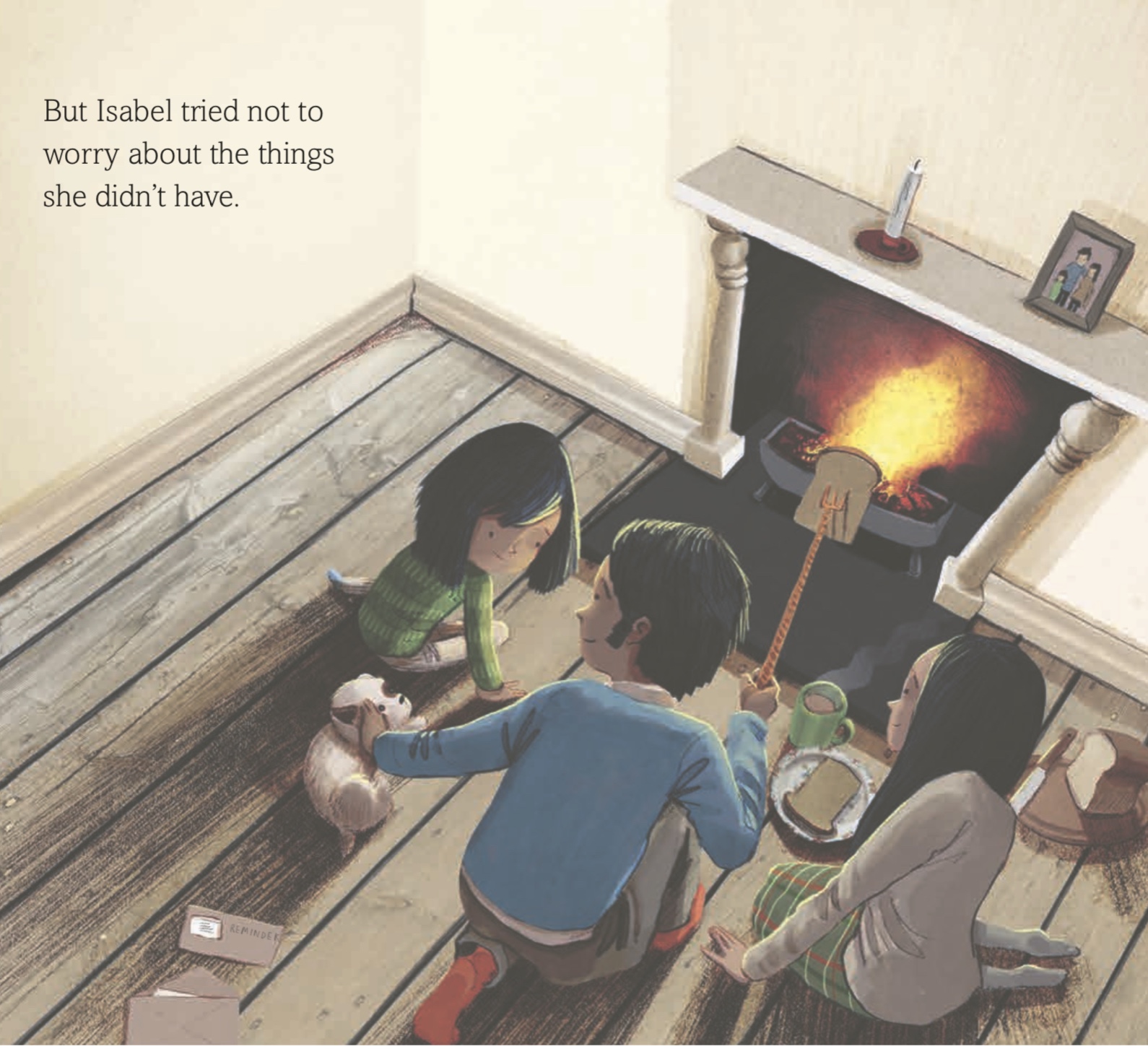
You feel the warmth of the fire, the family sitting around it.
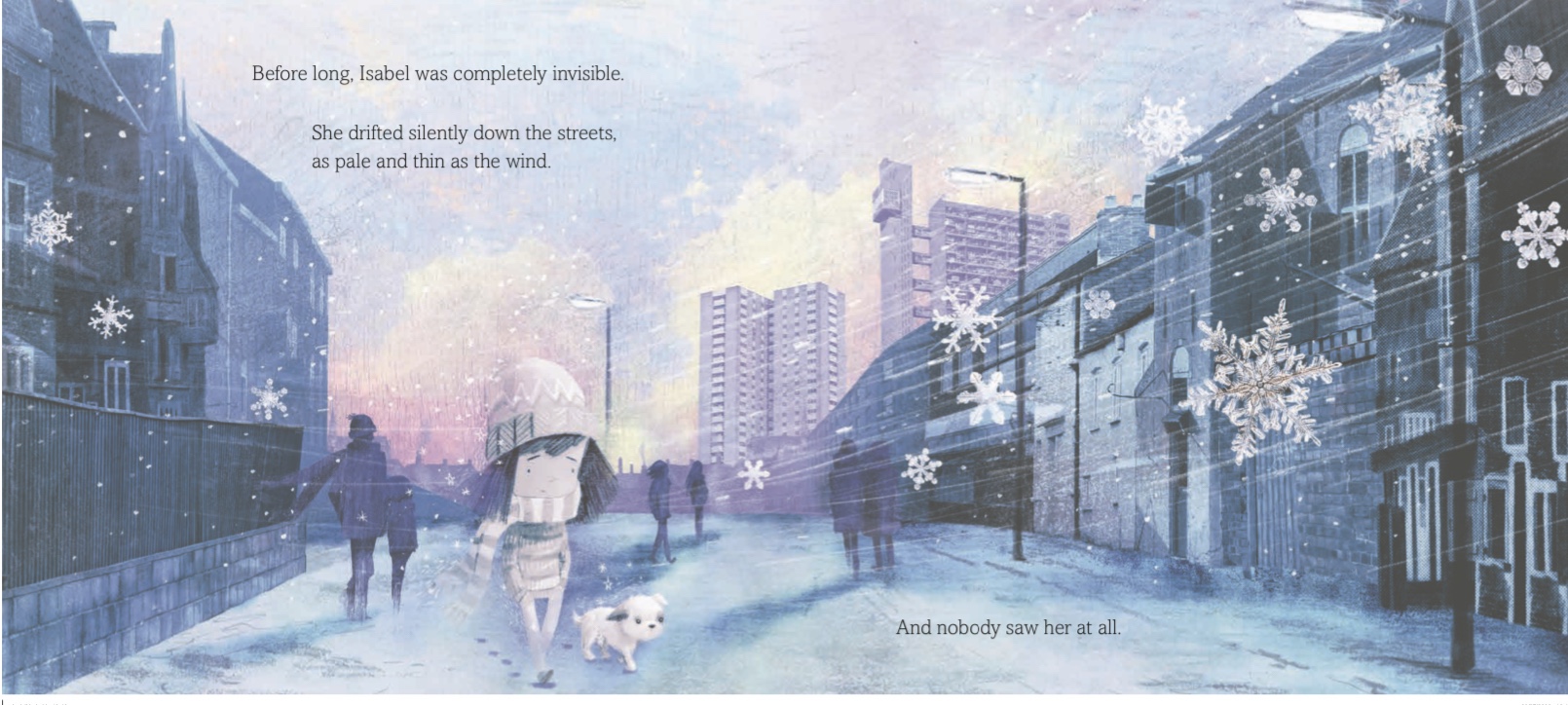
You feel the invisibility of Isabel as she wanders around her new neighbourhood.
You feel hope when she realises she has made a difference.
Tom Percival has based this story on his own lived experiences. There are too many still living this experience.
We all have a place, somewhere we belong. It is not just poverty that can make people invisible to others. This book is an excellent way into having these unfortunately necessary discussions.
The message of hope the book delivers is powerful. It reminds us that small acts can make a big difference. It reminds us to look for the helpers.
I received an eARC from NetGalley and Simon & Schuster UK Children’s to review. Thank you





 Beth's Bookcase